Real Estate Myths Buyers and Sellers Need to Ignore

    Damien and Jeremy answer a listener's budget-split question with real market data, then fact-check five commonly repeated real estate myths against the evidence.

    Damien & Jeremy

    Damien & Jeremy

    9 min read

    Listen to podcast

    In this episode, Damien and Jeremy first respond to a detailed listener question about splitting a property budget, then work through a published article covering five common real estate myths, testing each against their own experience and data.

    Listener Shoutouts

    Before the main topic, Damien reads out two positive listener comments from Spotify (from Ziggy Elo and chapman.sam1), thanking them for their support and feedback.

    Listener Question: Buy One Cheaper Property or One Bigger One?

    A listener asks whether, with a $110,000 cash position, it's better to buy a cheaper property now and a second one a year later, or commit fully to one larger property upfront.

    Jeremy explains his answer depends heavily on which price point is currently seeing the strongest market conditions. If the hottest price bracket nationally happened to sit around $400,000–$500,000, he'd lean toward the cheaper, diversified option; but if the hottest conditions were closer to $700,000, he'd prefer to be fully invested in the higher price point rather than split funds across a less competitive price bracket, even though he generally likes diversification in principle.

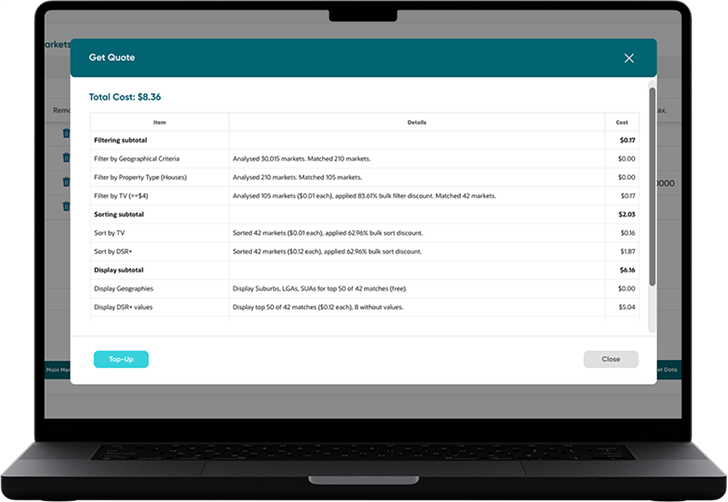
    Damien pulls up a live database analysis (as of July 2024) filtering for suburbs with typical values between roughly $300,000 and $700,000 with strong demand-to-supply indicators. The results showed almost no genuinely hot markets near the $300,000 mark, with most opportunities clustered nearer $650,000–$700,000, spread across significant urban areas including Perth (10 suburbs), Townsville (9), and Melbourne (8, notably concentrated in outer, more affordable pockets rather than inner-city Melbourne). Based on this, Damien and Jeremy agree that for this specific listener's circumstances, splitting the budget into two ~$300,000–$350,000 purchases wasn't realistic given where genuine market strength actually sat, making a single, fully invested purchase around $650,000 the more sensible option.

    Damien models this using lenders mortgage insurance (LMI) at 88% LVR on a $650,000 purchase, requiring around $104,000 in total cash (deposit, purchase costs, and a capitalised LMI premium of around $10,000), leaving a small buffer from the original $110,000. He notes this approach maximises how much of the investor's own cash is put to work, since a smaller cash contribution generally produces a stronger return on investment than fully cash-funding the deposit.

    Jeremy and Damien also model a subsequent equity release: assuming 10% capital growth in the first year (moving the $650,000 property to around $715,000, wait, they use $750,000 as a purchase price reference), while the loan balance stays flat (interest-only), the loan-to-value ratio would fall from around 90% down to around 81%, potentially allowing an equity release of roughly $47,000–$50,000 toward a second property, generally for a modest top-up LMI premium (as little as $1,000, rather than a full new premium) if staying with the same lender. Both note this kind of growth might realistically take two to three years to eventuate, but illustrates a practical pathway to a second purchase without requiring a large additional cash injection.

    Myth 1: You Can Time the Market

    The article claims market timing is a myth, arguing buyers should focus on personal financial readiness rather than trying to pick a moment, and that since property is a long-term hold, growth will average out over time regardless of entry timing.

    Jeremy disagrees firmly with this framing. While he agrees personal financial readiness matters, he argues that with modern data-driven analysis, timing entry into specific markets is genuinely achievable, describing this as increasingly realistic in what he calls "the data age," compared to a decade or more ago. He also challenges the article's underlying logic directly: precisely because growth tends to average out the longer a property is held, an investor aiming to outperform actually benefits from a strategy of shorter, more deliberate holds (buying, capturing above-average growth, then reallocating) rather than passively holding long-term and accepting an average outcome. He notes the benefit of long-term holding is more about protecting against a poor initial selection (an underperforming property eventually reverting toward the average) rather than a strategy for genuinely getting ahead.

    Both agree that timing considerations become more important the closer an investor is to retirement, since a shorter investment horizon leaves less room to ride out an underperforming period, whereas younger investors generally have more time to recover from a less-than-ideal purchase.

    Myth 2: Prices Will Crash

    The article argues that predictions of a major property crash are a perennial, unfulfilled claim, and that historically, Australian property prices rise more than they fall over time, with immigration and constrained supply cited as ongoing supportive factors.

    Jeremy agrees prices have historically risen more than they've fallen at the national level, and that a sweeping 20–30% national crash hasn't eventuated despite regular predictions, but pushes back on treating this as a blanket guarantee. He notes individual suburbs and markets absolutely can and do experience significant downturns, even if the national aggregate holds up, and that this distinction matters enormously to an investor whose specific property underperforms, regardless of how the national market performs overall. His overall takeaway aligns with the article's practical advice: it's more productive to plan for the specific market being entered than to wait indefinitely for a hypothetical broad crash that may never occur.

    Myth 3: Lost Borrowing Power

    The article acknowledges that rising interest rates have reduced borrowing capacity for many buyers, but suggests this shouldn't be assumed to rule out getting a loan altogether, recommending buyers check their position across several lenders.

    Jeremy and Damien largely agree with the practical advice here (shop around, get pre-approval, understand your actual position) while noting the framing of this being a "myth" is a little confusing, since rising rates genuinely do reduce borrowing capacity, that part isn't false. Damien adds practical context: working with a mortgage broker rather than a single lender directly can reveal meaningffully different borrowing capacity across providers, and that factors like paying down HECS debt or removing a car lease can also help improve capacity, worth exploring with a broker rather than assuming a rate rise is an automatic dead end.

    Myth 4: Renting Is Cheaper Than Buying

    The article argues home ownership is generally preferable to renting for long-term financial positioning, particularly heading into retirement.

    Damien offers a more nuanced take, raising the concept of "rentvesting": renting in a location an investor wants or needs to live in (which may have limited capital growth potential, such as an inner-city apartment), while directing investment capital toward markets with genuinely stronger growth prospects elsewhere. Jeremy frames this as a probability question: given there are thousands of suburbs across the country, it's statistically unlikely that the specific place someone wants or can afford to live in also happens to be the single best-performing location to own property, so renting where you need to live while owning where the numbers make sense can be a more effective long-term strategy than defaulting to buying only where you live.

    Myth 5: You Need a 20% Deposit

    The article notes that various options exist to buy with less than a 20% deposit, including government-backed home guarantee schemes (allowing as little as 5% deposit while avoiding LMI, subject to eligibility caps) and guarantor arrangements using a parent's property as security ("bank of mum and dad").

    Damien and Jeremy agree entirely with this point, consistent with their own discussion of these strategies in Episode 11. Damien reiterates his own comfort with using LMI deliberately (rather than avoiding it) as a way to reduce the upfront cash needed, given the premium is typically capitalised into the loan and tax-deductible over five years for an investment property, while cautioning that going in with a smaller deposit does mean taking on proportionally more leverage, worth discussing directly with a broker. Both note that with a parental guarantor arrangement, the borrower remains fully responsible for the loan, the risk to parents specifically arises only if the borrower defaults, and that some clients have even used a guarantor for an initial purchase before self-funding a second purchase within 6–12 months once cash reserves allowed.

    Closing Thoughts

    Damien and Jeremy close by reiterating the value of working through real data (price points, block sizes, surrounding suburbs) before making a purchase decision, rather than relying on generalised claims from any single source, their own included.

    Tagged:

    LMI StrategyRentvestingDeposit OptionsMarket TimingReal Estate Myths