

Investors spend a lot of time looking into properties listed below the suburb median. They believe the median will drag their property's value up.
Cheaper properties surrounded by more expensive ones should benefit. That is the claim.
It is not how property valuation works.
The Median Cannot Drag Anything Up or Down
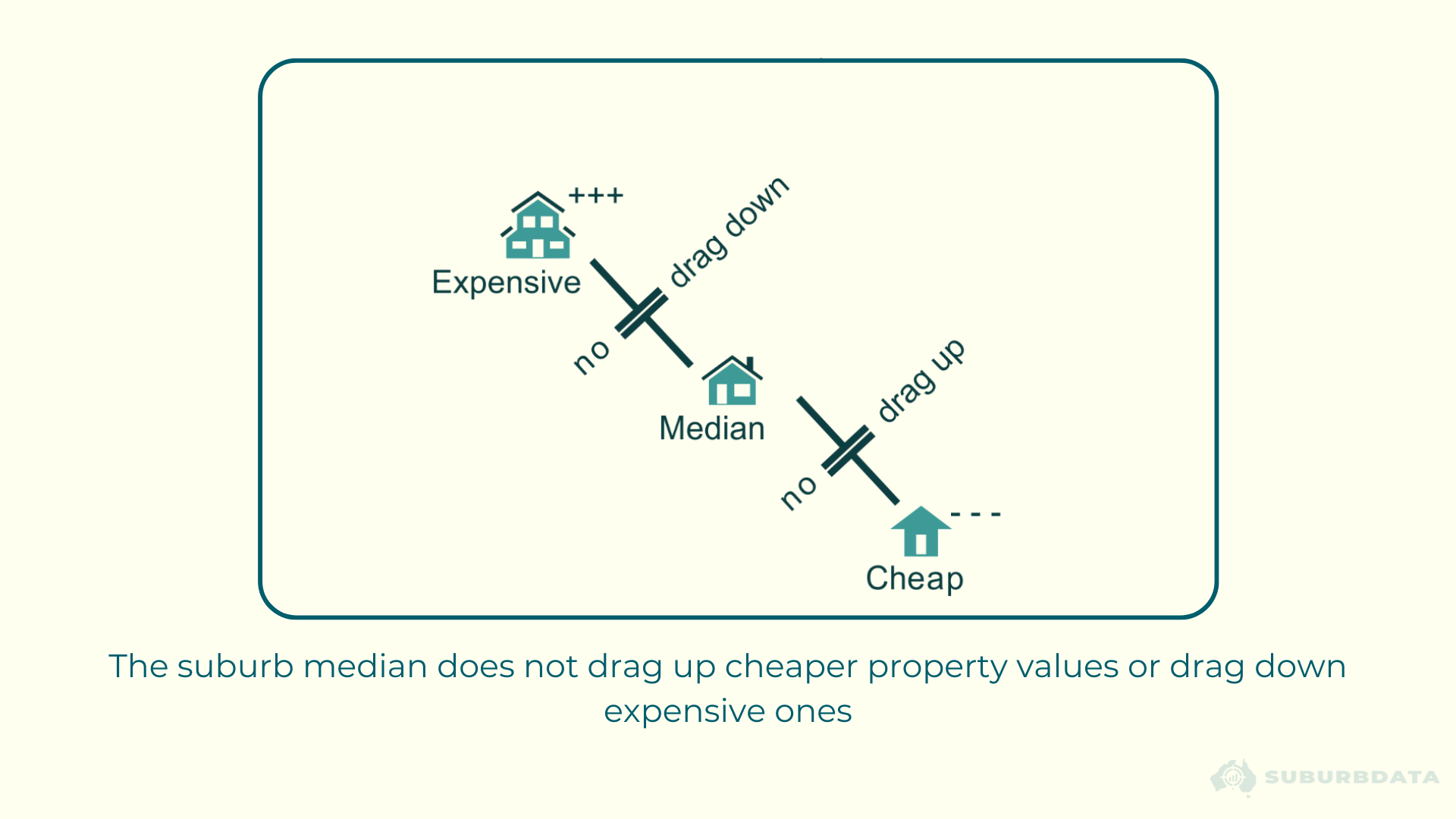
If the median dragged cheaper properties up, it must also drag expensive properties down. That is the same logic applied in reverse.
Imagine a suburb with two properties:
- A small property on a busy road next to a petrol station
- A large property on a quiet street backing onto a park
If the drag theory held, both properties would converge to the same value over time.
They never do. Features determine value. The median does not.
The Median Has Nothing to Do With Valuation
Property valuations ignore the suburb median entirely.
A professional valuer estimates value using one method: Comparable Market Analysis (CMA). Three things determine what is comparable:
- Similarity: same property type and features
- Proximity: what is nearby
- Recency: sold recently
The diagram below shows how CMA works in practice. Three criteria. All three must be met. The suburb median does not appear anywhere in the process.
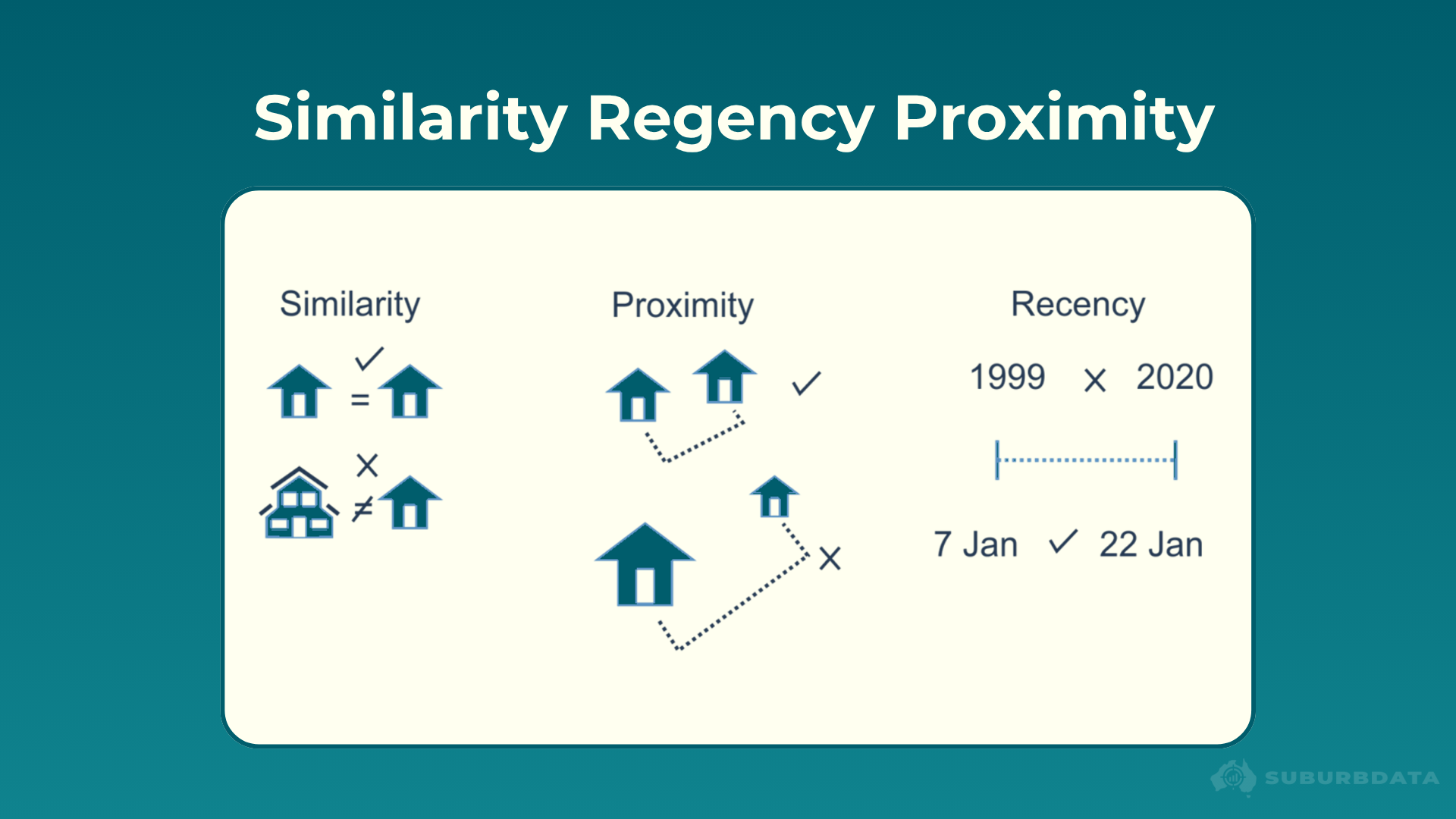
A sale from five years ago is out. A sale three suburbs away is out. The suburb median is never in.
Every property is valued on its own merits. A cheap property is cheap for a reason. Nothing nearby changes that.
Cheap Does Not Mean Good Value
A property below the median is not necessarily a good deal. It is below the median for a reason.
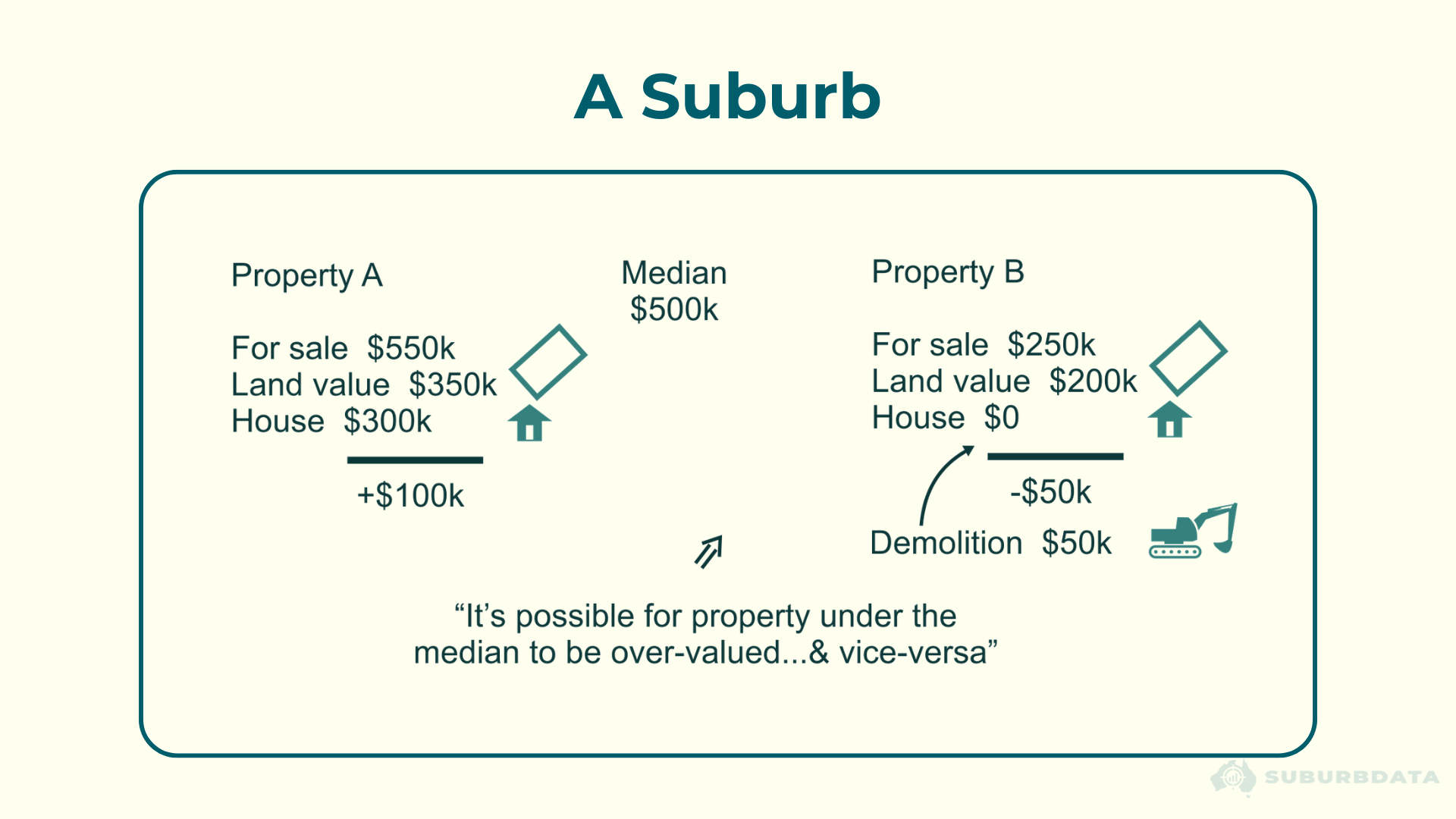
The diagram below shows two properties in the same suburb.
The Opportunity Cost
Focusing only on properties below the median eliminates half the market. That cost compounds in three ways:
- Miss half the market. Every property above the median is ruled out regardless of its actual value.
- Median anomalies. Monthly medians are unreliable. In thinly traded suburbs a single month of cheaper sales pushes the median down artificially. The next month nothing is available below it.
- Hot markets. Halving your search doubles your time to purchase. At 2% monthly growth on a $500,000 property, one extra month costs $10,000.
The 12-month medians on free websites like realestate.com.au and Domain reflect prices from up to a year ago. In a suburb that has grown over that period, it is possible there is nothing for sale below that figure.
- Property A: listed at $550k. Above the median. Land value $350k. House value $300k. Intrinsic value $650k. Under-valued by $100k.
- Property B: listed at $250k. Well below the median. Land value $200k. Demolition cost $50k. Effective value minus $50k. Over-valued by $50k.
Price relative to the median tells you nothing about whether a property is good value or not.
What Actually Determines Growth
Buying above or below the median has no influence on a property's performance.
What matters is demand and supply.
There is only one useful thing the buy-under-the-median advice reveals. It clearly identifies a fake expert.
Conclusion
The suburb median does not drag cheaper properties up. It plays no role in professional valuation. It is not a measure of good value. Using it as a filter eliminates half the market, causing opportunity cost.
Buying below the median has no influence on growth.
What matters is demand, supply, and what the property is actually worth. Find that. Ignore the median.