

Depreciation is often promoted as a tax benefit in property investing, but the reality is very different. This article breaks down what depreciation actually is, how it affects capital growth, why tax deductions don’t make you better off, and why high-depreciation properties consistently underperform over the long term.
Introduction: The Depreciation Myth
Many property investors believe depreciation is a good thing.
They think of it as:
- A tax trick
- Paperwork
- A government handout
Some even seek out properties with the highest depreciation.
That belief is wrong.
Depreciation is not a benefit. It is not free money. And it is not something investors should want more of.
In this Expert Busting episode, we unpack what depreciation actually means, how tax distorts the conversation, and why high-depreciation properties often destroy long-term wealth.
What Depreciation Actually Is (And Isn’t)
Depreciation is
- A decrease in value
- Caused by age
- A loss
Depreciation is not
- A tax dodge
- A government handout
- Free money
Depreciation represents the reality that buildings become less valuable over time. The loss is real, it is not merely a section on a tax return.
Land Appreciates. Buildings Depreciate.
This distinction sits at the core of property investing.
Land tends to increase in value due to scarcity and demand. Buildings do the opposite.
Depreciation applies only to the building, not the land.
As buildings age:
- Materials wear out
- Layouts date
- Fixtures and fittings deteriorate
Land goes up. The dwelling on top of it goes the other way.
Why Depreciation Exists
Buildings do not last forever.
Every structure has a finite effective life:
- Roofs age
- Kitchens date
- Bathrooms wear
- Fixtures become obsolete
Depreciation is simply the formal recognition of that decline.
From a tax perspective, the ATO allows investors to acknowledge that loss progressively rather than pretending the building never ages.
That does not make the loss a benefit.
The Role of the ATO and Quantity Surveyors
What the ATO Does The Australian Tax Office sets standard depreciation rates based on:
- Asset type
- Expected effective life
What Quantity Surveyors Do Quantity surveyors:
- Identify depreciable items
- Estimate original values
- Apply ATO depreciation rules
- Produce a depreciation schedule
A depreciation schedule estimates how much value the building and its components lose over time.
It does not create money. It measures value already lost and to be lost in the future.
Division 43 vs Division 40 Explained
Division 43 – Capital Works
- Structural elements of the building
- Walls, roof, concrete, fixed components
- Residential properties eligible if built after 15 September 1987
- Reduces the CGT cost base
Division 40 – Plant and Equipment
- Removable or mechanical items
- Air conditioning, ovens, carpets, blinds, light fittings
- For properties purchased after 9 May 2017, second-hand items are generally not deductible
- Handled separately for CGT purposes
Either way, depreciation represents real value loss.
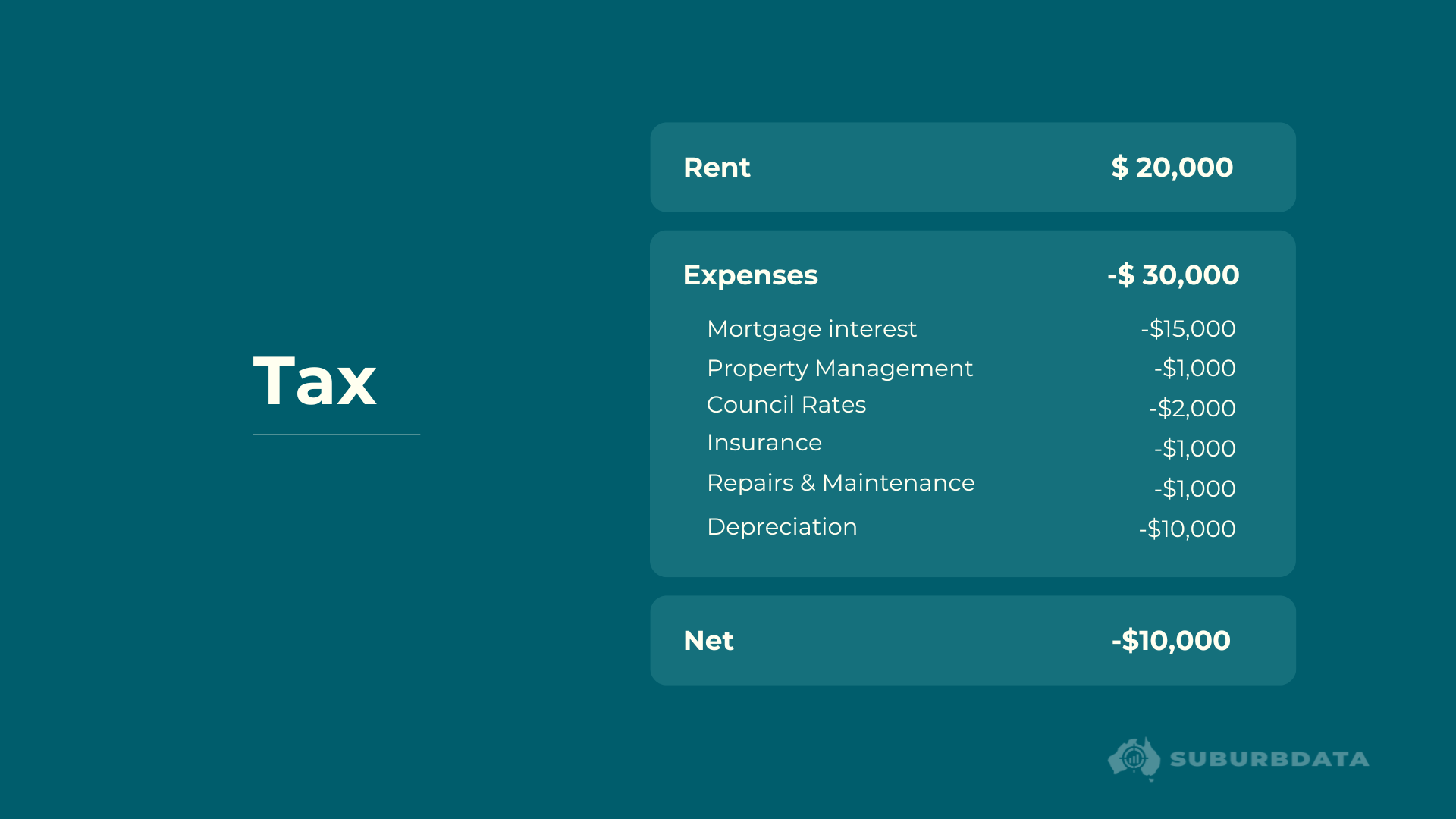
Tax: Where Investors Get Confused
Tax is paid on net profit, not gross income.
Rental income is reduced by expenses such as:
- Mortgage interest
- Property management
- Council rates
- Insurance
- Repairs and maintenance
- Depreciation
If expenses exceed income, a loss is recorded.
That loss reduces taxable income. It does not increase wealth. It is still a loss.
You Don’t Get Depreciation “All Back”
This is the most misunderstood part of depreciation.
If you claim $10,000 in depreciation:
- You do not get $10,000 back
- You recover only a portion, based on your tax rate
Example
- Depreciation claimed: $10,000
- Marginal tax rate: 40%
- Tax saved: $4,000
You are not better off by $4,000.
You are worse off by $6,000.
You lost $10,000 in asset value and recovered only part of it by paying less tax.
Depreciation vs Repairs and Maintenance
These 2 concepts are often confused.
Repairs and maintenance
- Immediate cash costs
- Fix something broken
- Fully deductible
- Examples: hot water system, damaged carpet
Depreciation
- Occurs even if nothing breaks
- Reflects gradual loss over time
- Happens whether you spend money or not
The building becomes less valuable before replacement is required.
Example: The Back Deck
- Deck cost: $40,000
- Expected life: 40 years
- Depreciation rate: 2.5%
- Annual depreciation: $1,000
Assume:
- Salary: $100,000
- Taxable income after depreciation: $99,000
- Marginal tax rate: 40%
Result
- Tax saved per year: $400
You are still worse off by $600 per year compared to owning a property with an older deck that does not depreciate.
After 40 Years: The Catch
After 40 years:
- Total tax saved: $16,000
- Deck value: $0
A valuer would factor in the cost of replacement.
Your position has gone backwards by $24,000.
Depreciation softened the loss. It did not remove it.
Selling: The Hidden Consequence
Depreciation comes back to bite you when you sell.
Example
- Bought for $400,000
- Depreciation claimed: $30,000
- Cost base: $370,000
- Sold for $600,000
- Capital gain: $230,000
You pay more capital gains tax.
The ATO effectively claws back what you claimed in earlier years.
There is no free ride.
“Depreciation Benefits” Don’t Exist
There is:
- No such thing as depreciation “benefits” - it is a detriment
- Nothing beneficial about losing value
- Only partial recovery of a loss
Tax deductions reduce the impact of depreciation.
They do not turn it into a gain.
Where the Bad Advice Comes From
High-depreciation properties are often promoted by:
- Tax accountants focused on short-term tax reduction
- Property developers selling new stock
- Sales teams posing as investment advisors
New properties typically:
- Have high depreciation
- Smaller land components
- Lower long-term capital growth
If given the choice between:
- A new property with high depreciation
- An older property in the same suburb
The older property will outperform over time.
This is a mathematical certainty.
Summary: What Actually Matters
Appreciation is good. Depreciation is bad.
The worst properties for depreciation are new properties. They have 100% of their construction cost left to lose.
Older properties tend to offer:
- Lower depreciation
- Higher land value
- Stronger long-term capital growth
Final Thought
Depreciation is not a benefit. It is a detriment.
The goal is not to maximise depreciation. It is to minimise it, while maximising exposure to land and long-term growth.