

One of the most common reasons investors are encouraged to buy new property is tax depreciation.
On paper, depreciation schedules can look impressive, especially in the early years.
This article breaks down how tax depreciation actually works, why it does not improve investment performance, and why new properties often underperform established homes once capital growth and land value are taken into account.
Depreciation Is Not a Benefit
Depreciation is often described as a benefit. It is not.
Appreciation is capital growth. Depreciation is negative growth.
If an asset depreciates, it is losing value. That loss is real, even if part of it can be claimed as a tax deduction.
What Depreciation Actually Means
Depreciation is the loss of value of a building due to ageing.
Land appreciates. Buildings depreciate.
Depreciation applies to the dwelling only. It does not apply to land.
How Depreciation Is Calculated
In Australia, depreciation rates are set by the ATO.
Quantity Surveyors estimate construction costs and apply these rates to calculate how much value the building loses each year. This produces a depreciation schedule.
A depreciation schedule does not show profit. It shows how value will be lost over time.
Depreciation as a Tax Deduction
Depreciation is one of several expenses that can be claimed against rental income.
Other deductible costs include mortgage interest, council rates, insurance, management fees, and repairs and maintenance.
This is where many investors misunderstand how depreciation works.
Tax Depreciation Report
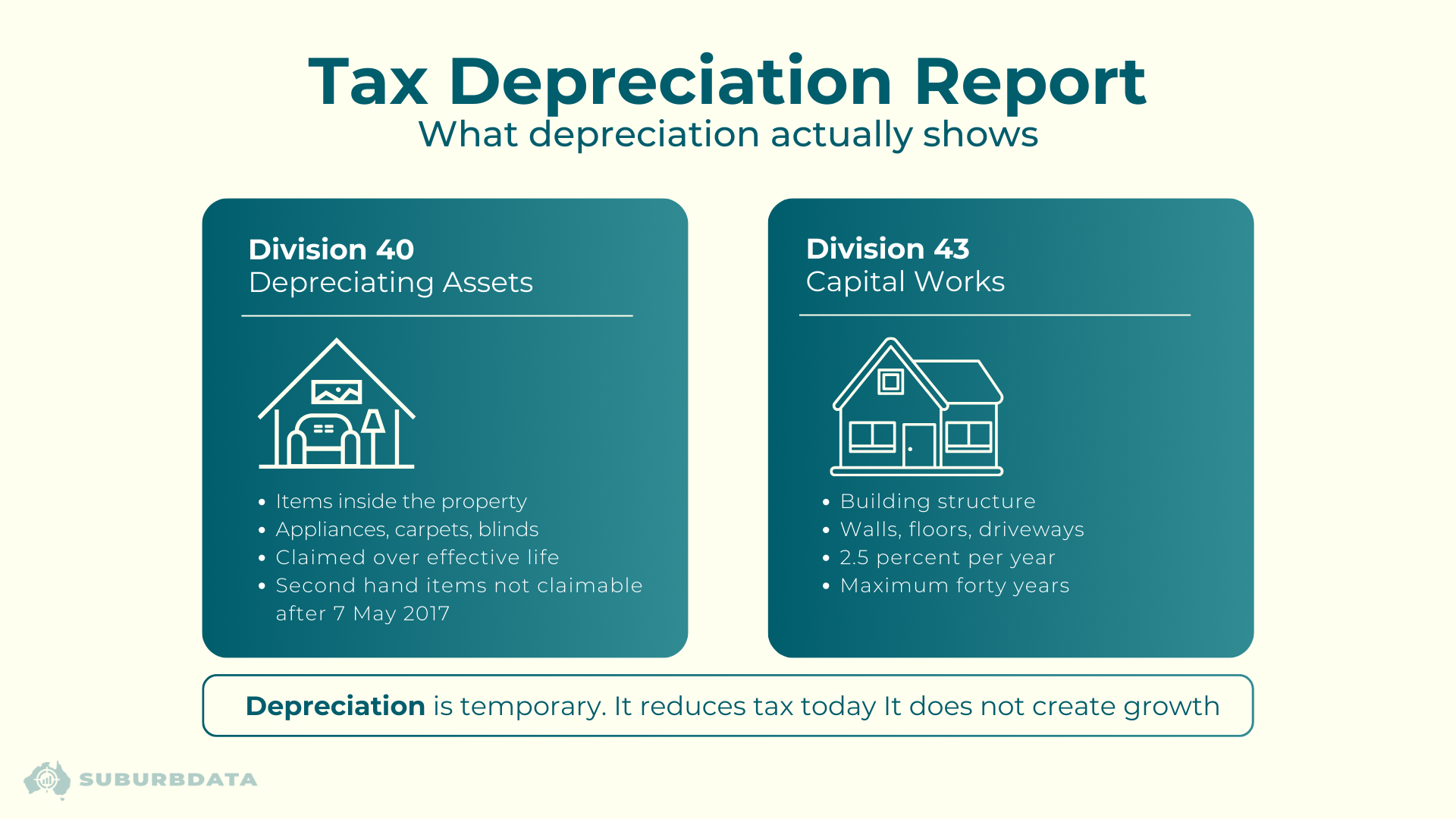
A tax depreciation report outlines the deductions an investor can claim against rental income over time.
It is often presented as a major advantage of buying new property, but many investors misunderstand what the report is actually showing.
A depreciation report does not measure investment quality. It simply documents allowable tax deductions under Australian tax law.
To understand why depreciation is often overstated, you need to understand the two components it is made up of.
Division 40 Depreciating Assets
Division 40 covers items inside the property that wear out over time.
This includes appliances, carpets, blinds, air conditioners, and other removable assets.
Each item has an effective life set by the ATO. Depreciation is claimed gradually over that lifespan.
For example, an oven may be claimed over 10 years.
Division 43 Capital Works Deductions
Division 43 relates to the building itself and permanent structural components.
This includes walls, floors, roofs, slabs, and driveways.
Eligible buildings allow a deduction of 2.5% per year for 40 years after construction.
Only properties built after 15 September 1987 qualify.
Once the 40-year period ends, the deduction stops completely.
Division 43 does not grow. It does not compound. It declines until it reaches zero.
How a Tax Depreciation Report Is Presented
A typical tax depreciation report presents deductions year by year, often stretching over forty years.
Early years usually show higher deductions, which makes the report look impressive.
But what the report is really showing is timing. It shows the rate at which assets are wearing out.
The report does not show land value. It does not show capital growth. And it does not show long term investment performance.
You Do Not Get It All Back
If you claim $10,000 in depreciation and your marginal tax rate is 40 cents in the dollar, your tax bill falls by $4,000.
You are not better off by $4,000. You are worse off by $6,000.
Depreciation reduces tax. It does not eliminate loss.
New Versus Old How Depreciation Behaves
New properties depreciate the fastest.
As buildings age, depreciation slows and eventually stops, generally after around forty years.
This difference in timing matters and sets up the comparison between new and old property.
Property Value = Land + Dwelling
Every residential property’s value is made up of 2 components:
The land. The dwelling on top of it.
To compare new and old fairly, assume 2 properties are purchased at the same time, for the same price — 1 new and 1 old.
Same Price Starting Point
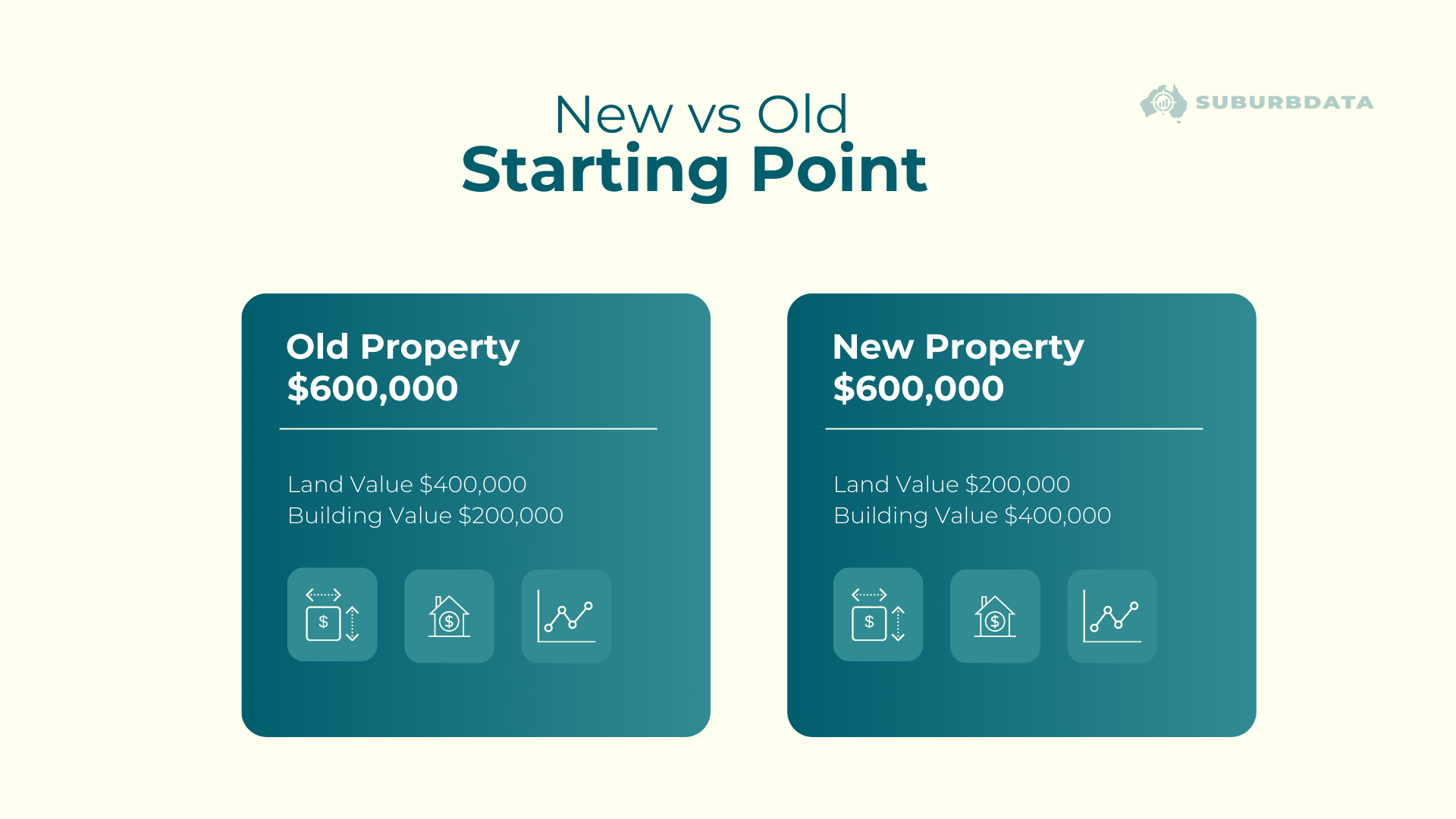
Both properties cost $600,000.
The difference is not the price. The difference is how that price is allocated.
The old property starts with most of its value in land. The new property starts with most of its value in the building.
Numerical Breakdown
The old property begins with approximately $400,000 in land and $200,000 in building. This results in a land-to-asset ratio of around 67%.
The new property begins with approximately $200,000 in land and $400,000 in building. This results in a land-to-asset ratio of around 33%.
This structural difference drives everything that follows.
10 Years Later: Appreciation and Depreciation
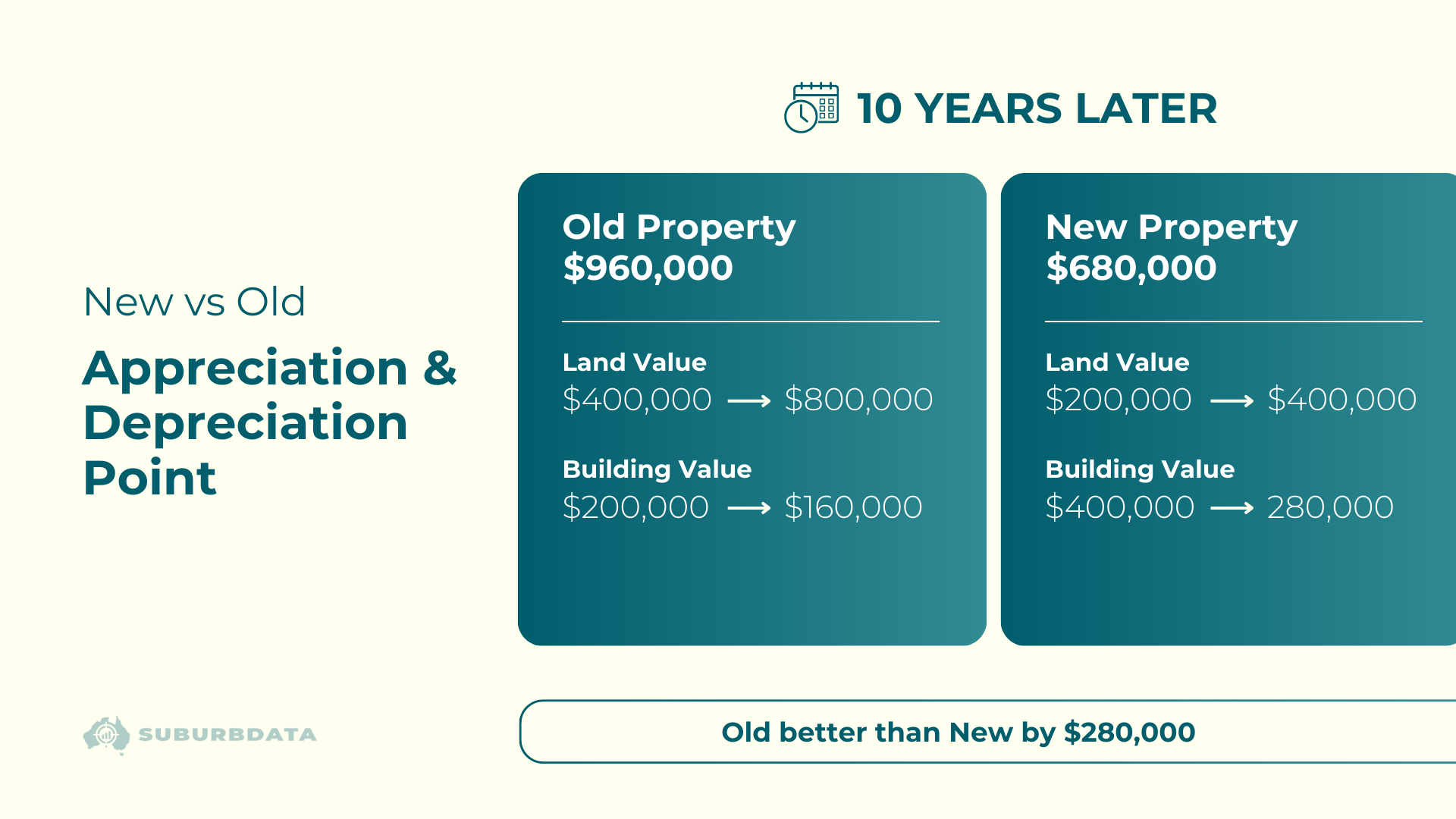
Assume the same land growth rate for both properties over 10 years.
Land values increase. Buildings depreciate.
After 10 years:
- The old property is worth approximately $960,000
- The new property is worth approximately $680,000
The old property is ahead by $280,000 before tax.
Tax Considerations
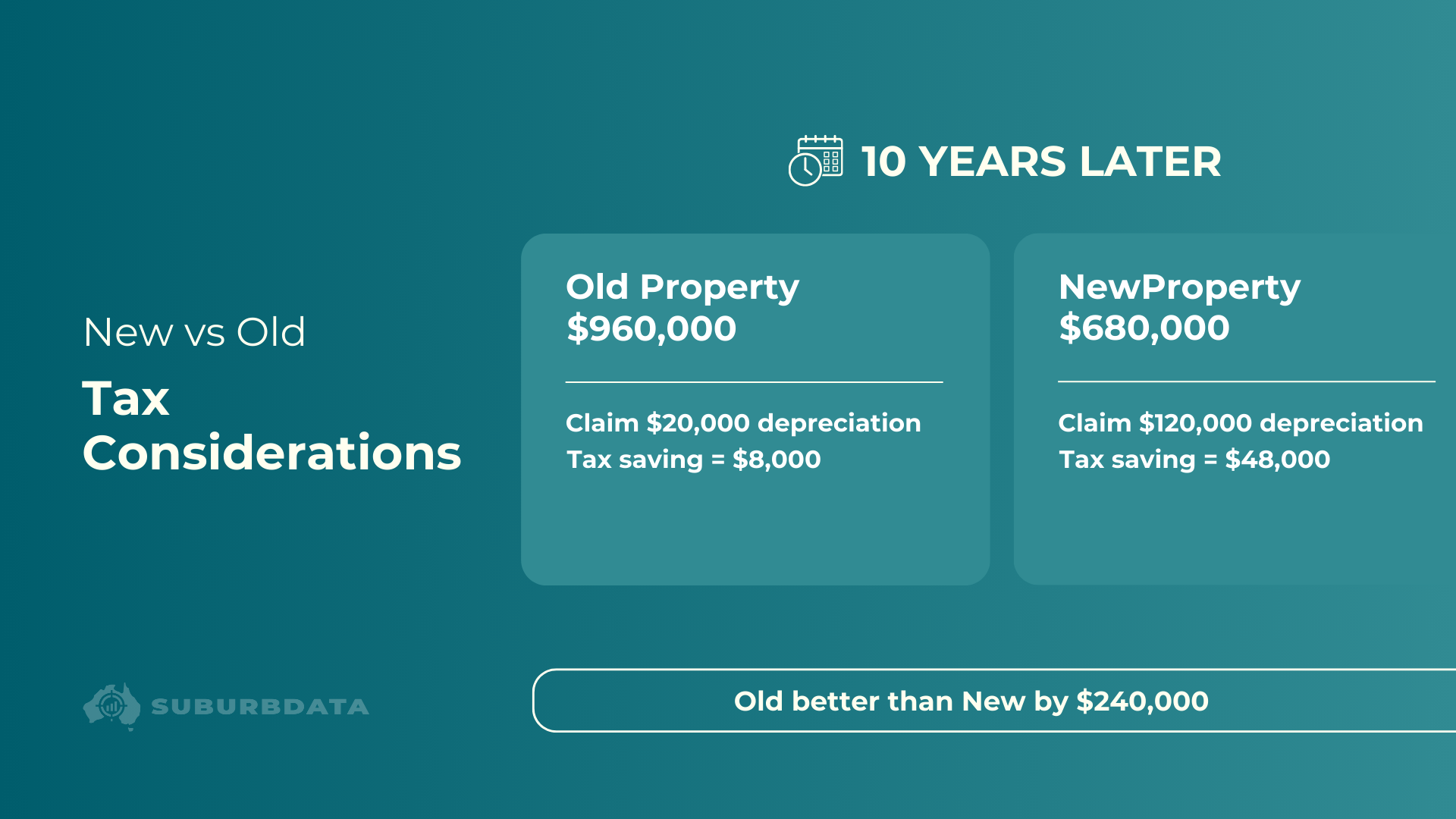
Over the same period, the new property claims significantly more depreciation than the old property.
At a 40% marginal tax rate, this reduces tax payable. It does not reverse the outcome.
After tax savings are included, the old property is still ahead by approximately $240,000.
Cash Flow Adjustments
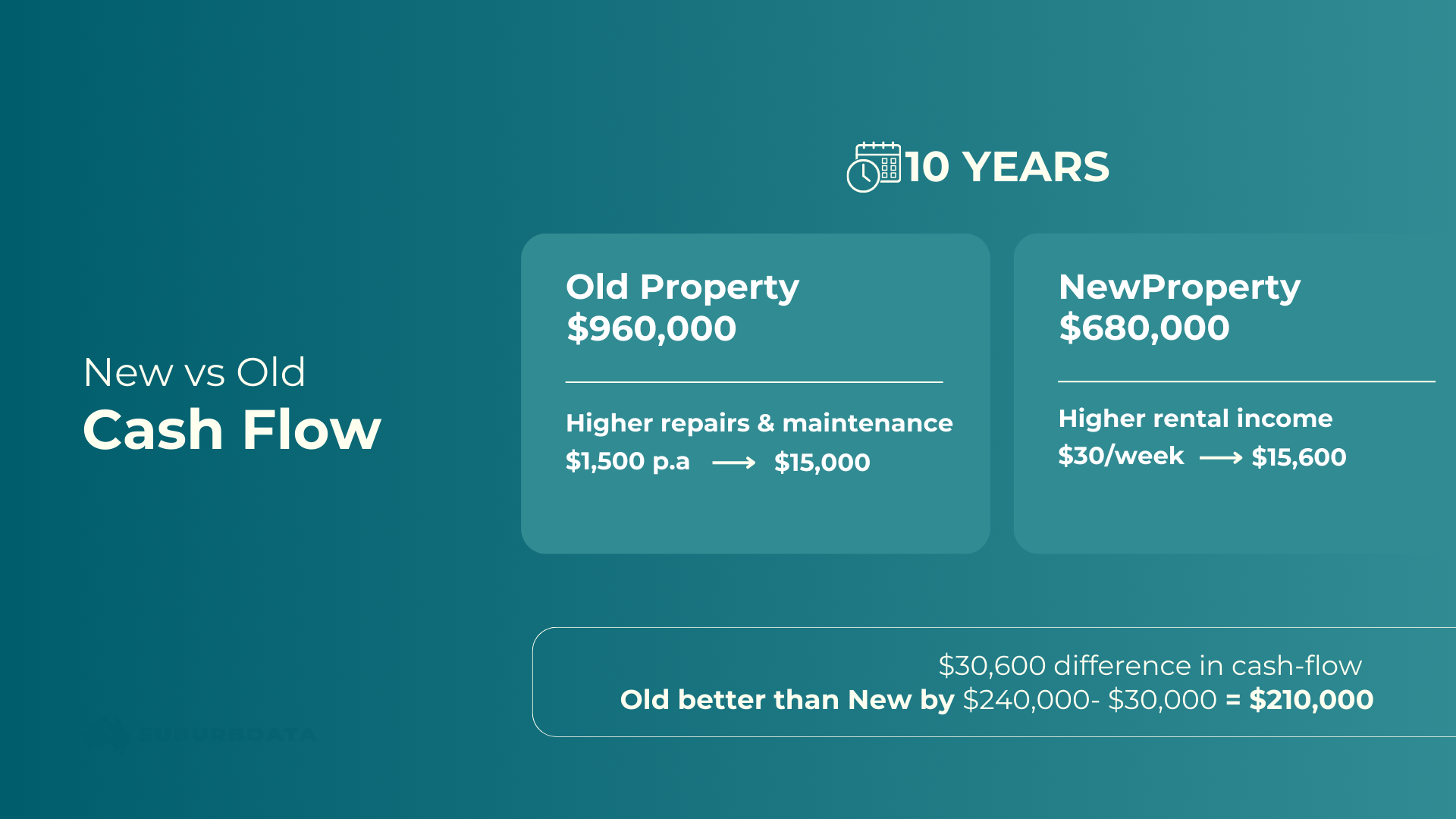
To keep the comparison fair, we adjust for:
Higher repairs and maintenance on the old property
Higher rental income on the new property
Even after these adjustments, the old property remains ahead by around $210,000.
Repairs and maintenance are also deductible, yet no one refers to “repair and maintenance benefits.”
The phrase “depreciation benefits” is a marketing construct.
Vacancy Assumptions
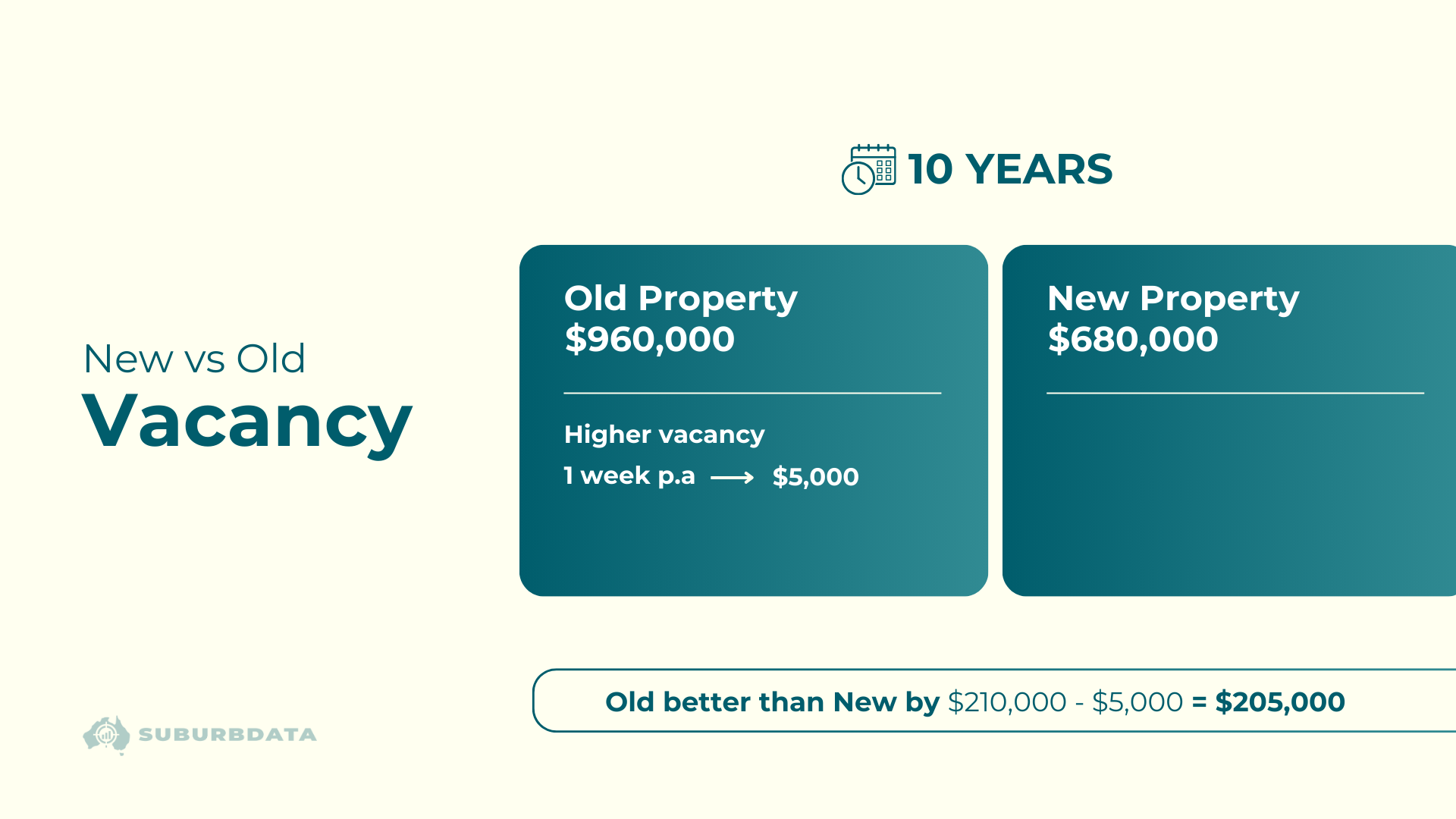
Assume the old property experiences 1 additional week of vacancy per year.
After 10 years, the old property is still ahead by approximately $205,000.
Stamp Duty and Grants
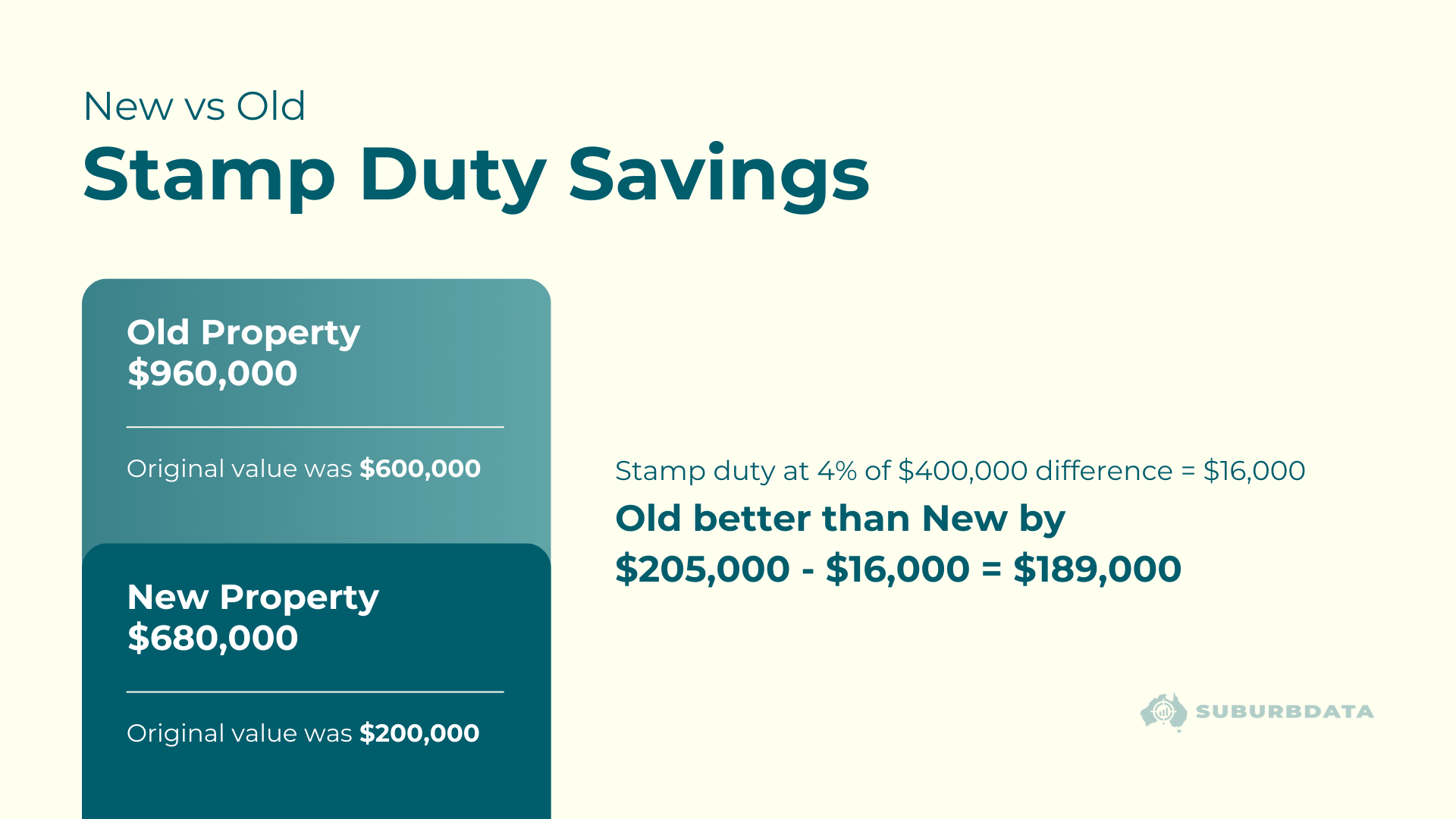
New properties may benefit from stamp duty savings and government grants.
Even after allowing for these advantages, the old property remains ahead by roughly $189,000.
Interim Result
$600,000 new versus $600,000 old.
Same land growth. All adjustments included.
The old property still performs better.
Eventually New Becomes Old
New properties do eventually behave like old ones.
But this takes decades.
By the time a new property reaches a similar land to asset ratio, years of underperformance have already occurred.
Land to Asset Ratio Explains Why
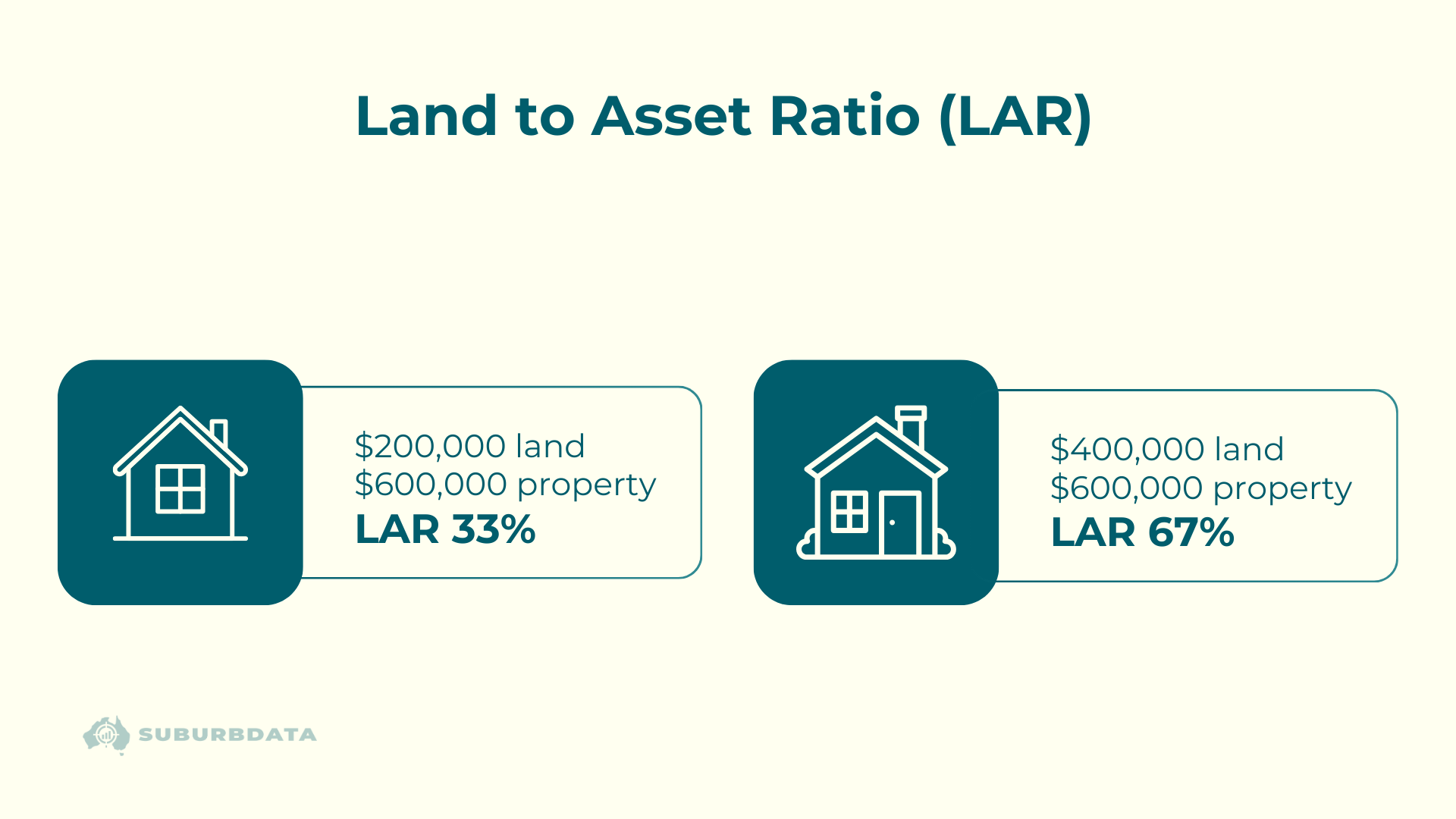
As buildings depreciate, the land to asset ratio increases.
Growth improves not because the building gets better, but because the building becomes less relevant.
Real World Examples
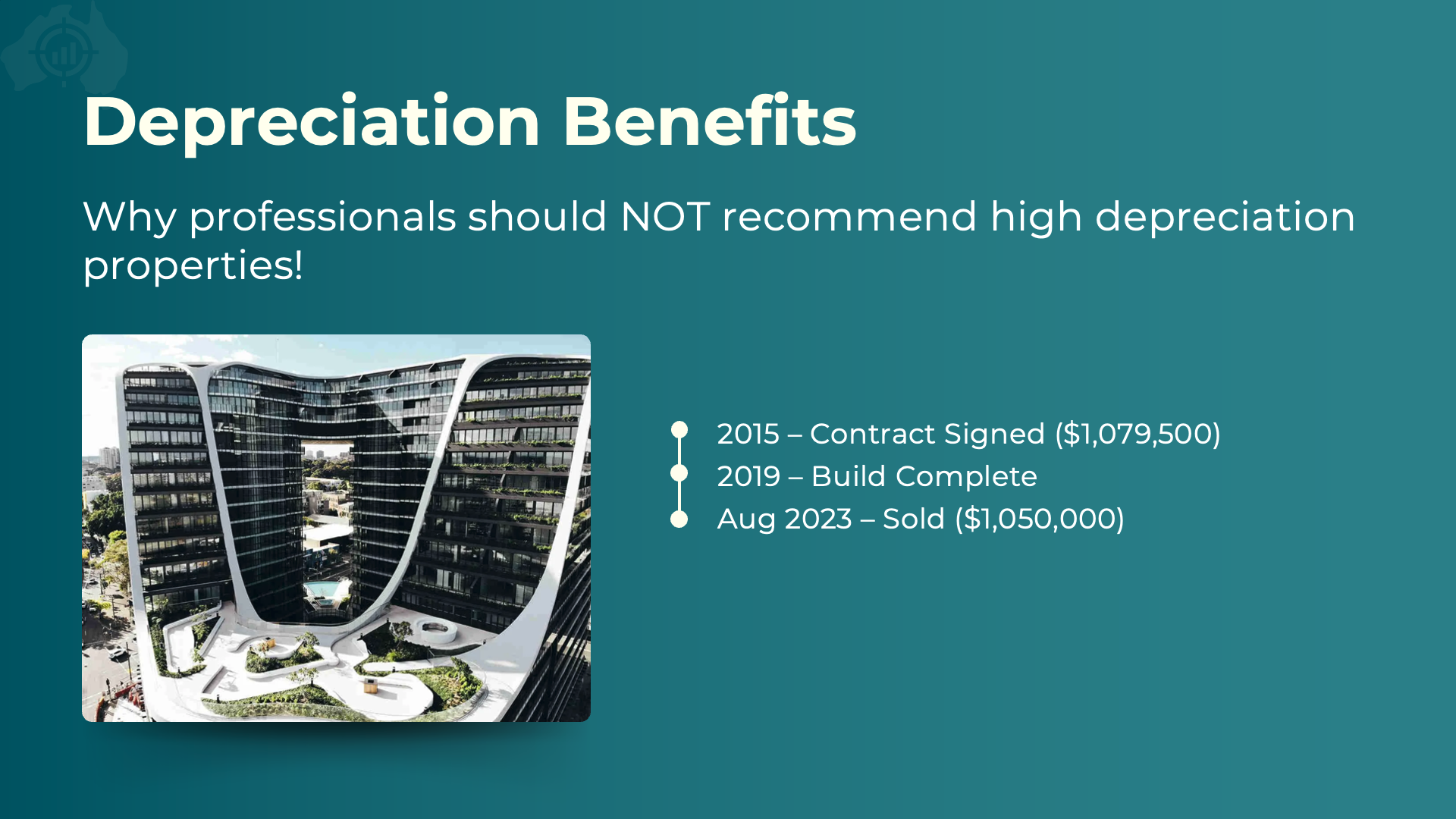
Real world examples of high depreciation properties show long holding periods, weak capital growth, and depreciation that fails to compensate for poor structure.
Why You Can’t Renovate New Property
With a new property, there is little meaningful value left to unlock.
The dwelling is already finished. The design is already optimised for sale. The price already reflects that work.
Any renovation done early is unlikely to add value beyond what it costs.
This is what people mean when they say you “can’t renovate new property.” Not that you can’t change it — but that there is no value gap left to exploit.
Renovate or Rebuild: Where the Profit Comes From
Every property will need work eventually.
Older properties require renovation sooner than newer ones. This is often framed as a downside. In practice, it can be an advantage.
Renovation is not just a cost. It is a way to create value.
If you spend $50,000 on a renovation and increase the property’s value by $80,000, the difference is your profit.
That uplift belongs to you.
Becoming the Developer Instead of Paying One
Established property gives investors an option that new property does not.
They can rebuild.
If you knock down the existing dwelling and construct a new one yourself, you take on the development risk — but you also capture the development margin.
That margin is the profit.
When you buy new, you pay cost plus developer profit. When you renovate or rebuild yourself, that profit changes hands.
It becomes yours.
Why This Matters Structurally
This difference explains a key performance gap between new and old property.
With new property:
- Value is created before purchase
- The uplift is already priced in
- The developer captures the margin
With established property:
- Value can be created after purchase
- Renovation or rebuild creates upside
- The investor captures the margin
This is not about effort. It is about who benefits from value creation.
The Bigger Picture
When investors avoid older properties because they “need work,” they often avoid the very mechanism that drives outsized returns.
Maintenance is a cost. Renovation is an opportunity.
New property removes that opportunity entirely.
And that is one more reason established property consistently outperforms brand-new property over the long run.
Selling, Depreciation, and Capital Gains Tax
Depreciation is often discussed as if it exists independently of the rest of the investment lifecycle. It does not.
If you ever sell an investment property, capital gains tax applies. And when the ATO calculates that tax, it adjusts your cost base for any depreciation you have claimed.
Every dollar of depreciation claimed over the life of the property is deducted from the cost base.
A lower cost base means a higher taxable capital gain.
In practical terms, the more depreciation you claim while owning the property, the more capital gains tax you are likely to pay when you sell.
This is where many investors are caught off guard. Depreciation reduces tax in the early years, but increases tax later. It is not a permanent tax saving. It is a timing shift.
Depreciation does not eliminate tax. It defers it.
Incentives Matter More Than Advice
Before acting on any property advice, there is one question to ask your advisor that matters more than almost any other:
How do you get paid?
If any part of the transaction involves money flowing from a developer — whether as a commission, referral fee, embedded margin, or marketing arrangement — incentives are immediately misaligned.
That payment may be described in different ways:
- A sales commission
- A profit margin built into the construction price
- A “group discount” that still preserves developer profit
- A referral or marketing fee
The label does not matter. The direction of money does.
Developers and their partners are paid when property is sold. They are not paid based on how that property performs over the next ten or twenty years.
This single fact explains much of the advice investors receive in the new-property market.
How Developers Actually Make Money
To understand why new property is structured the way it is, you need to think like a developer.
Developers make money by adding value and selling projects. They do not make money by holding land long term.
Land and construction are costs. Value uplift is the product.
When land represents a large proportion of the total project cost, developer profitability suffers. Even if a project makes money in absolute dollars, the return on capital can be unattractive.
High land cost:
- Ties up capital
- Reduces percentage returns
- Limits scalability
This is why developers actively seek to minimise land costs wherever possible.
Why Cheaper Land Improves Developer Returns
If the same project is built on cheaper land, returns improve.
Lower land cost means:
- The same uplift represents a larger percentage gain
- Capital efficiency improves
- Return on investment increases
Even so, many projects remain only marginally attractive to developers.
The important point is not the exact return figure. It is the direction of incentives.
As land becomes cheaper, developer returns improve.
That incentive never reverses.
Ideal Projects for Developers
The most attractive development projects for developers are those where land is a relatively small part of the total cost.
In these scenarios:
- Land is cheap
- Construction dominates the spend
- The uplift represents a meaningful percentage of the total investment
This is where developer returns become acceptable.
And this is precisely the structure most commonly sold to investors as brand new property.
Why Investors and Developers Want Opposite Things
Developers want the lowest possible land-to-asset ratio.
Investors want the highest possible land-to-asset ratio.
These goals are fundamentally incompatible.
By the time an investor buys a new property:
- The developer has already captured the value uplift
- The land component has been minimised
- The dwelling component has been maximised — and will depreciate
This is not a judgement about intent. It is simply how the economics work.
And it explains why new properties consistently underperform established ones over time.
What the Data Shows
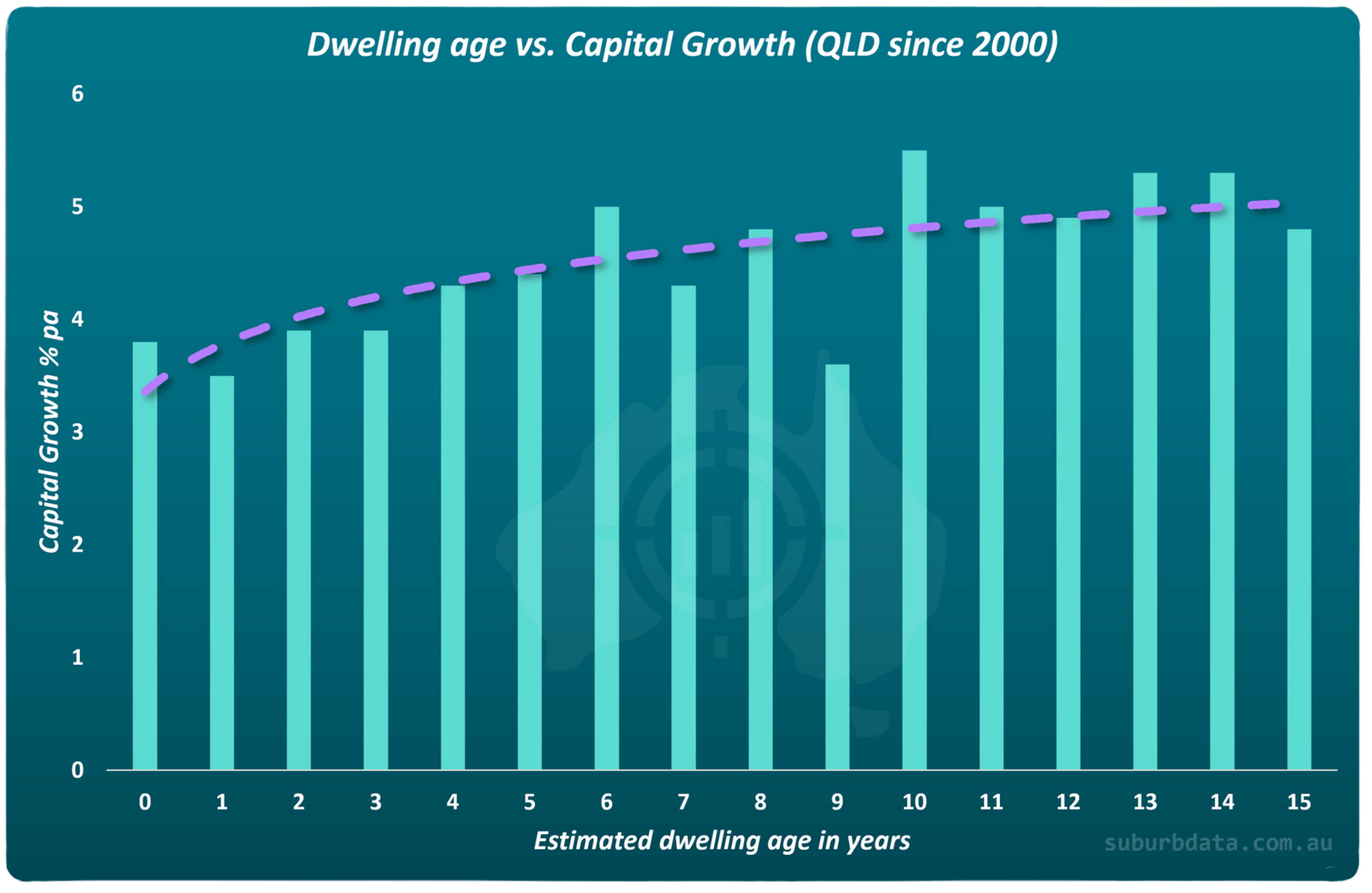
Historical data from Queensland shows capital growth by dwelling age.
Newer dwellings sit at the bottom. Older dwellings consistently outperform.
This confirms what the mechanics already showed.
Final Conclusion
Do not buy new property for investment purposes.
You can make money buying new. It is just less likely.
If you want a new property, build it yourself. Be the developer and capture the value.
Depreciation does not create wealth. Appreciation does.