

Auction knock-out bids (also called slam bids) are promoted as a powerful auction strategy in Australia. But do they actually work? In Expert Busting Episode 9, we break down why knock-out bids rarely intimidate buyers and often cost more than they save.
The Myth of the Knock-Out Bid
Many so-called auction experts claim they have mastered the “knock-out bid.”
It’s sold as a psychological weapon. A decisive move. A way to intimidate competitors and shut the auction down early.
In reality, it is usually just expensive theatre.
In this episode of the Expert Busting Series, we unpack what a knock-out bid actually is and why it rarely delivers what it promises.
What Is a Knock-Out Bid?
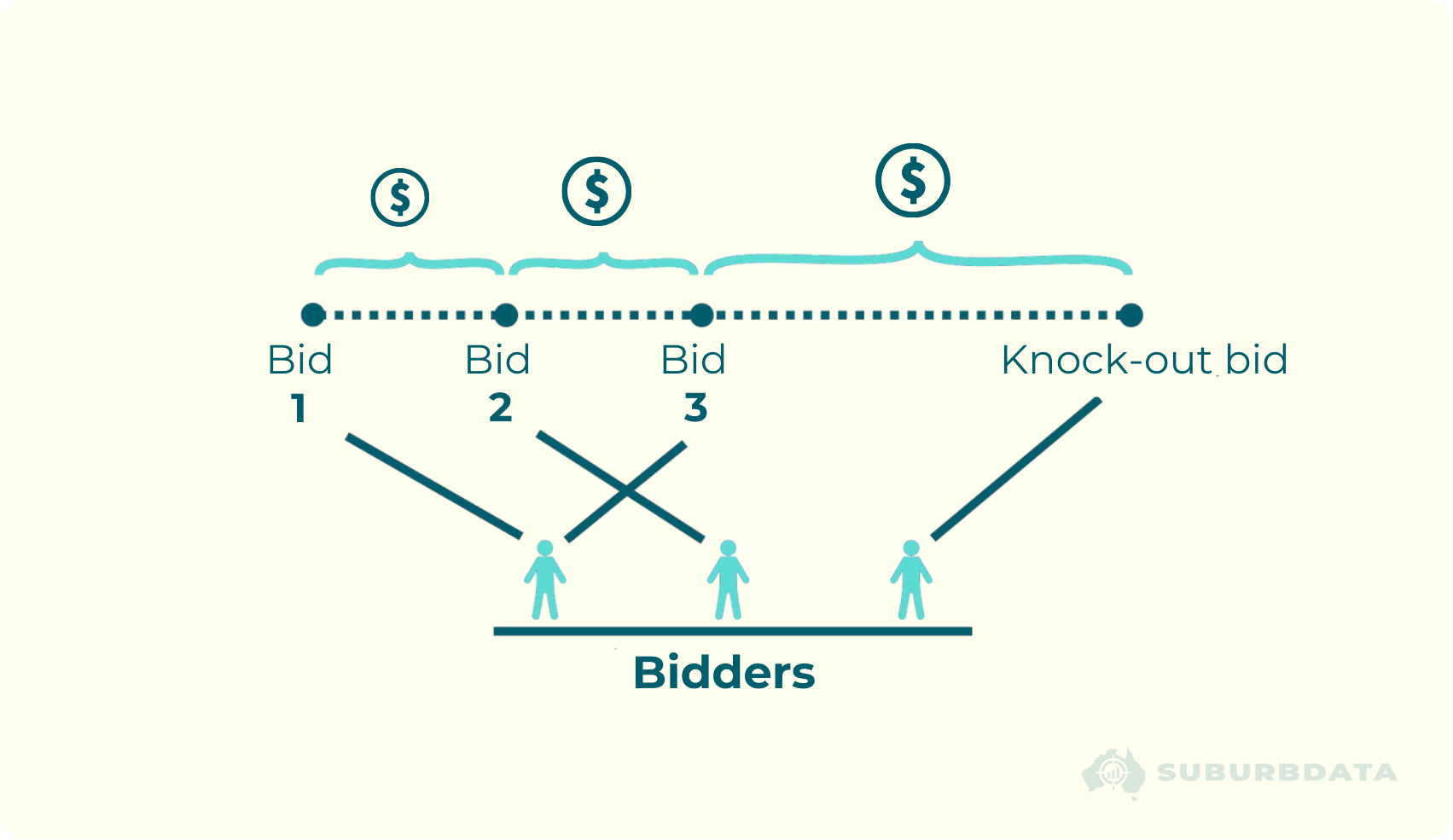
A knock-out bid is a large jump in price during an auction.
Instead of bidding in normal increments such as $1,000 or $5,000, a bidder suddenly jumps much higher.
For example, bidding reaches $510,000. Rather than going to $515,000, someone jumps straight to $530,000.
The theory behind this tactic is simple. You create the perception that you have deep pockets and unlimited capacity, hoping the other bidder gives up.
It sounds dramatic. It sounds powerful.
But it is unlikely to have much impact on the outcome.
What Happens Before Auction Day
By the time someone attends an auction, they have usually:
- Attended multiple inspections
- Discussed the purchase and committed to buying
- Paid for building and pest inspections
- Engaged a conveyancer
- Arranged finance
- Possibly obtained a valuation
They have invested time. Money. Emotion.
This is not casual.
So consider this carefully. Would someone who has done all of that simply walk away because another bidder jumped $20,000, even though the price is still below their budget?
Unlikely.
People stop bidding when they reach their ceiling, not when they feel intimidated.
Walking Through a Scenario
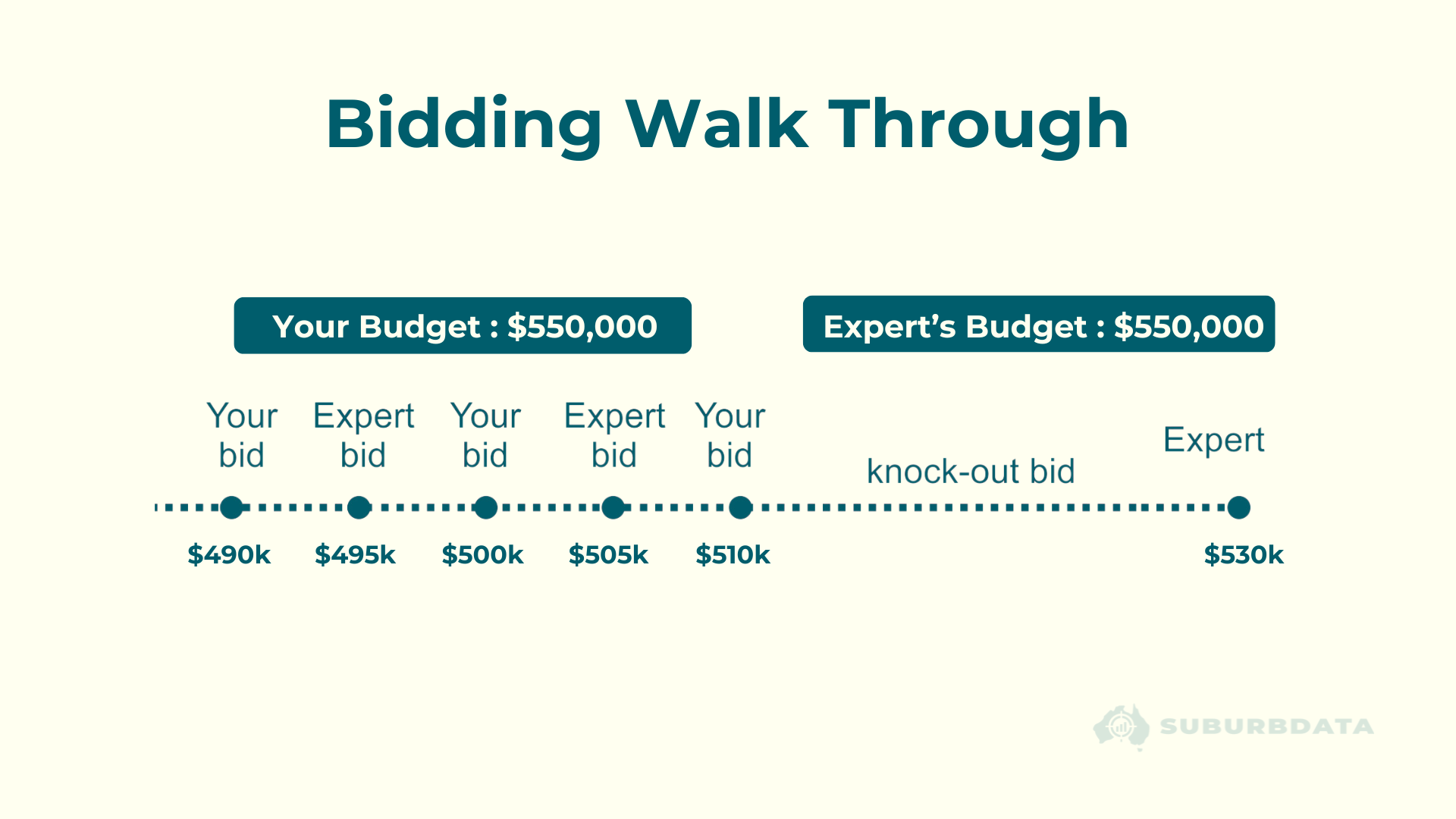
Let’s imagine both you and the so-called expert’s client have the same maximum budget of $550,000.
Bidding moves steadily from $490,000 to $510,000 in $5,000 increments.
Then the expert jumps to $530,000.
You still have $20,000 available before hitting your limit.
Why would you leave?
You wouldn’t. You bid again.
The knock-out bid changes nothing because it does not exceed your budget.
The auction continues exactly as it would have if bidding had moved up gradually.
The Only Number That Matters
The size of the increment is irrelevant.
The only thing that determines the outcome is the final price relative to each bidder’s maximum.
If a bid is below your limit, you continue. If it exceeds your limit, you stop.
Whether the jump was $5,000 or $20,000 makes no difference unless it crosses that threshold.
The knock-out bid does not win the auction. The highest bid does.
When It Appears to Work
Now adjust the scenario.
Your maximum is $540,000. The expert’s client can go to $550,000.
Bidding reaches $540,000. The expert jumps to $550,000.
You are out.
Did the knock-out bid work?
No. It simply exceeded your limit.
They could have won at $542,000. Instead, they jumped to $550,000 and may have cost their client an unnecessary $8,000.
The jump size was not the deciding factor. The final value was.
The Only Way to Prove It Worked
For a knock-out bid to genuinely prove effectiveness, three things would need to be true:
- The winning bid was the knock-out bid
- The losing bidder discloses their true maximum
- That maximum was lower than the knock-out bid
In other words, the losing bidder had more capacity but chose not to use it because they were intimidated.
In practice, this proof almost never exists.
Winning an auction is not evidence the tactic worked. You may simply have had the highest budget all along.
The Psychology Argument Falls Apart
Buyers do not abandon a property because someone appears confident.
They stop because they reach their financial limit.
No sunglasses, posture, timing strategy or dramatic jump changes a borrower’s capacity.
Auctions are arithmetic.
Not theatre.
The Other Auction “Advice”
You may have heard suggestions like:
- Arrive early
- Survey the competition
- Dress sharply
- Stand front and centre
- Wear sunglasses so others cannot read you
- Turn up in an expensive car
- Start strong and finish strong
None of these determine the outcome.
The highest bid wins.
Every time.
The Only Strategy That Works
There is only one tactic that works without fail.
Bid more than everyone else.
That is the entire system.
Everything else is performance.
Conclusion: Learn to Detect Marketing
Knock-out bids do not possess special power.
If you have more money than another bidder, you can simply bid incrementally until you move past their limit.
Large theatrical jumps may actually cost more than necessary.
Sometimes marketing is packaged as expertise.
Be sceptical. Ask for evidence. Question the logic.
Because in auctions, there are no tricks.
There is only one rule.
The highest bid wins.