

Investors are told to focus on land. Buy houses, not units. Buy bigger blocks. More square metres equals better performance.
The principle that land appreciates and buildings depreciate is correct. The mistake is what gets assumed next.
Bigger does not usually mean better. Square metres are not the metric. Dollar allocation is.
What Investors Think the Principle Means
Most investors translate "land appreciates" into three rules:
- Houses over units
- Bigger blocks over smaller blocks
- More square metres equals more growth
The first is partly true. Houses have outperformed units historically, probably because of land, and probably because of oversupply potential in the unit market.
The second is not a bad starting principle but misses the point.
The third is usually wrong.
Some industry professionals recommend buying any property with above-average block or floor size, regardless of whether it is a unit or a house.
Beware Developer Marketing Disguised as Education
Industry advice often aligns with stock being sold. Ratios and rules conveniently match what is on the developer's books.
If a blog claims to have discovered the ideal land-to-house ratio, and the seller's stock matches that precise ratio, the education is probably a sales pitch.
A lot of nonsense gets broadcast about land size.
If Land Matters Most, Raw Land Should Win
A raw block of land has 100% land component. By the more-land-is-better logic, it should outperform anything with a building on it.
Australian deserts have massive land size. Square kilometres of it.
Desert prices have not outperformed city prices in the last 40 years. If size were the answer, every investor would be buying desert.
Raw Land Has Structural Problems
Three reasons raw land usually struggles as an investment:
- Hard to finance. Lenders are reluctant to lend on land without a build plan. Leverage is limited.
- No rental income. Without a property to rent, there is no income stream.
- Poor tax treatment. No income usually means no deductions. Interest, council rates, and other holding costs are not tax deductible.
Raw land is not a terrible investment. It just has structural issues that often disqualify it from being the best.
The Right Question
The right question is not how many square metres. It is not block size versus floor size.
It is dollar allocation. How much of the purchase price is going to the appreciating asset (land) versus the depreciating liability (the building)?
The Land to Asset Ratio
Land to Asset Ratio (LAR) measures how much of the asset is land. It is the value of the land divided by the total property value, expressed as a percentage.
The chart below shows the calculation for a sample property valued at $500,000.
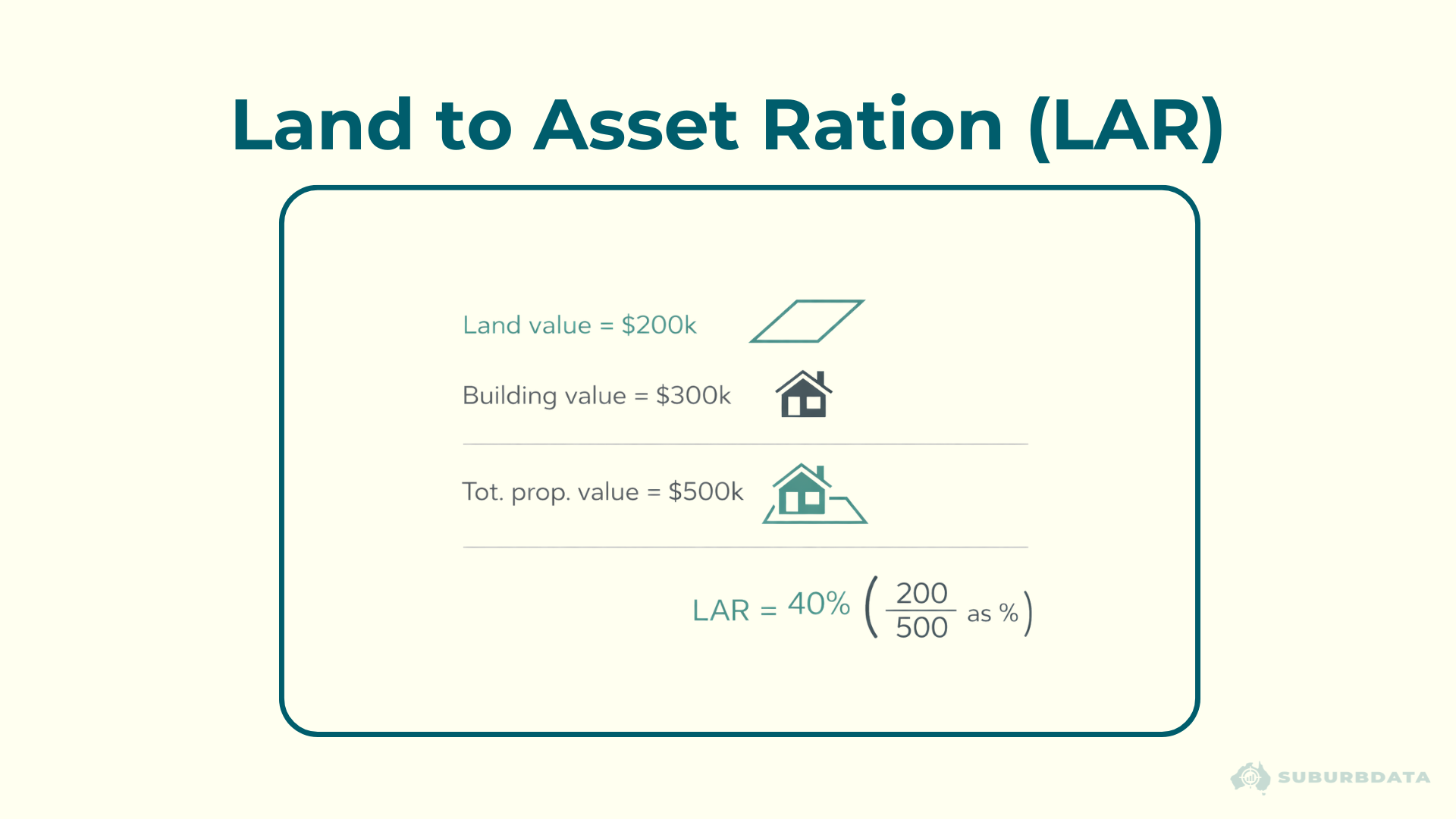
A property worth $500,000 with $200,000 land and $300,000 improvements has a LAR of 40%.
That is a low LAR. Anything below 60% is usually weak. The higher the LAR, the better.
Why LAR Matters
Land appreciates. Buildings depreciate.
The highest possible LAR means the highest proportion of the purchase price is going to the appreciating asset. The lowest proportion is going to the depreciating liability.
Capital growth comes from the appreciating part. Higher LAR means more of the asset is growing and less is shrinking.
Rental income comes from the building. Capital growth trumps rental income for wealth creation. Investors should prioritise growth over yield.
A Worked Example
Two properties both worth $500,000.
- Property A: $200,000 land, $300,000 building, LAR 40%
- Property B: $300,000 land, $200,000 building, LAR 60%
Same purchase price. Same suburb. Different structure.
Apply one year of identical assumptions: land grows 10%, building depreciates 2%.
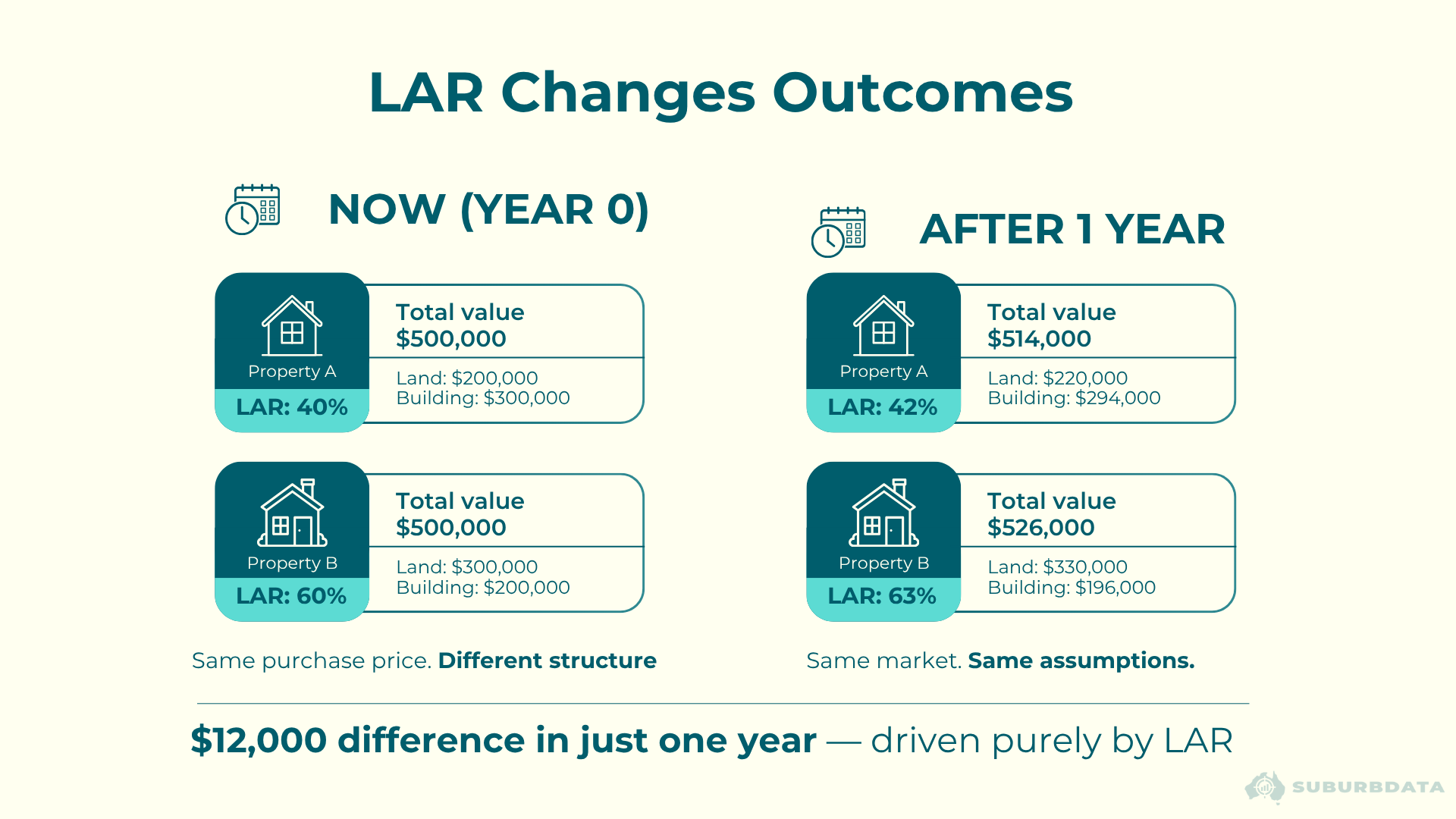
After one year:
- Property A: $514,000 (+$14,000)
- Property B: $526,000 (+$26,000)
Two properties of the same total value, in the same market, with the same growth assumptions. Property B grew nearly twice as much as Property A.
The reason is LAR. Property B had more of its value in the appreciating asset and less in the depreciating one.
Good LAR vs Bad LAR
The chart below contrasts the two extremes.
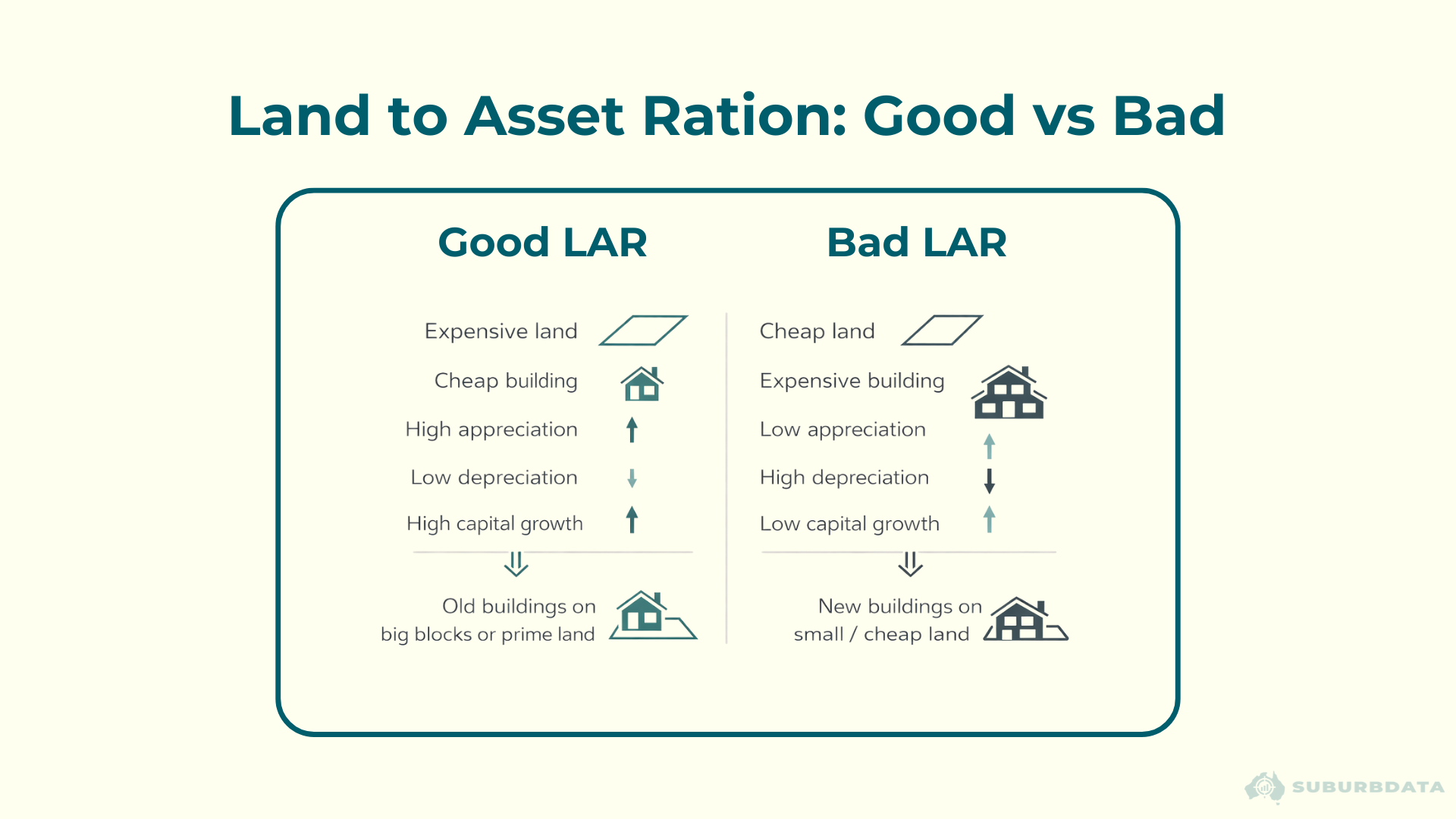
A high LAR usually means an old building on a big block, or any building on prime land. A low LAR usually means a new building on small or cheap land.
Some units have high LARs. The square metres do not matter. What matters is the value of that small piece of land under the building compared to the asset overall.
A 200-unit high-rise on a $20m block gives each unit $100,000 of land. If the unit costs $500,000, the LAR is 20%. The growth is usually appalling.
A 12-unit boutique walk-up on a $2.4m block gives each unit $200,000 of land. If priced at $500,000, the LAR is 40%. Still low, but twice as good.
The houses with the highest LARs are usually old. Older dwellings have already depreciated. The land has been appreciating the entire time. The LAR climbs as the building shrinks in value and the land grows.
New vs Old
New properties have a higher building value and a lower LAR. Older properties have higher land value and a higher LAR.
Many investors chase new properties for the depreciation tax benefit. The reasoning is that depreciation reduces taxable income.
This confuses a tax deduction with a return on investment. Depreciation is not a benefit. It is a detriment that gets partially recovered through tax.
A property losing value is not made into a winner by claiming the loss against income. The tax deduction does not come close to making up for it.
For a detailed comparison of new vs old, see topic #3 the nasty truth of new property.
Conclusion
Land size was never the point. Square metres do not drive growth.
- Raw land: structural problems, not the answer
- Bigger blocks: not bad, but misses the point
- Higher LAR: the metric that explains different outcomes in the same suburb
What matters is dollar allocation. The proportion of the purchase price going to the appreciating asset (land) versus the depreciating liability (the building).
A $500,000 property with 60% LAR will outgrow a $500,000 property with 40% LAR all other things being equal.
The advice to buy more land is not just wrong. It mistakes square metres for dollars.