

For decades the saying has been "rent money is dead money." The idea has been to own your home rather than rent it.
That doesn't make sense from a financial perspective. It is more likely that home mortgage money is dead money, not rent money.
It is more beneficial from a financial perspective to rent where you live than to own.
Out of the thousands of suburbs around Australia, what chances are there that the suburb you want or need to live in is also the best suburb for your investment dollars?
The problem with owning your home is that it is highly unlikely to be the best asset your money could buy at any point in time. Once that property market falls out of favour, perhaps goes through a slump, will you offload it like any other underperforming asset? Or will you be tempted to hang on since you live in it?
What Rent Actually Buys
Rent is not buying nothing. Rent buys something:
- Flexibility. No transaction costs to leave. No selling agent. No stamp duty on the next move.
- Location. Live where life works. Close to work, family, friends, the beach, the coffee.
- Agility. Reallocate capital when markets change. A rented home does not lock capital into one location.
Ownership Is Not Investment
Where you want to live is not always where your capital should be deployed. Feeling good about owning doesn't mean it is the highest-return decision.
Lifestyle is not asset allocation. Emotion is not return optimisation.
The Tax Difference
A rental property is usually more tax-efficient than your home. Investors can claim:
- Mortgage interest
- Repairs and maintenance
- Insurance
- Council rates
Homeowners cannot claim any of these.
These all make owning a rental property tax-efficient compared to owning your home.
The Opportunity Cost of Owning
Owning your home hinders the investor in three ways:
- Capital locked in one location. A home you live in cannot be reallocated when a different market starts performing better.
- No flexibility to chase growth. You cannot easily sell your home when that market peaks and move to a different market starting to boom. Your whole life has to move.
- Tax-inefficient biggest asset. The largest asset in most household balance sheets has none of the deductions an investment property has.
Rentvesting
Owning an investment property while renting where you live is called rentvesting.
Jeremy Sheppard: I first started rent-vesting in 2004. I had 6 investment properties back then, but I didn't own my principal place of residence. I realised that it was better to own in a growing market and rent close to work, family, and friends. I prefer living in a unit because of the ease of maintenance. But houses make for better long-term investments. I was able to claim a tax deduction on all the expenses these investment houses incurred, which was very tax-efficient. But more importantly, they grew in value at a faster rate than the value of the unit I was living in. The yield on the houses I owned as investment properties was actually better than the yield my landlord was getting.
The rentvesting investor is the landlord and the tenant at the same time. Different properties, different roles, different markets.
Same Timeframe. Different Outcomes.
The chart below compares two 5-year periods ending in 2020 and 2025 across 8 capital city markets.
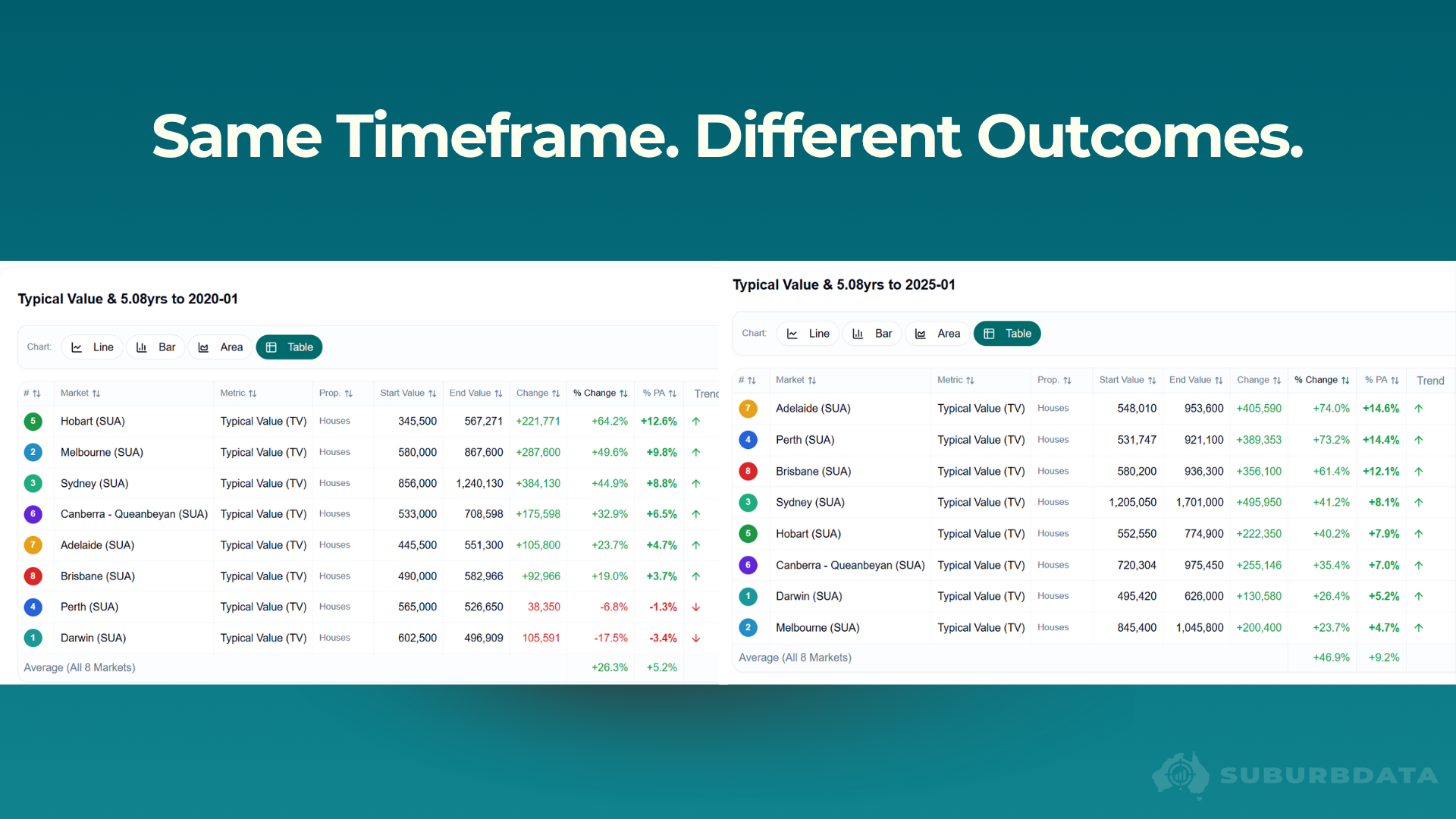
- Period 1: 5 years to January 2020. Average growth 5.2% per annum. Perth declined 1.3% pa. Darwin declined 3.4% pa.
- Period 2: 5 years to January 2025. Average growth 9.2% per annum. Every market positive. Adelaide led with 14.6% pa.
- Same length of time. Very different city-level outcomes.
The cities that led in one period lagged in the other. Perth went from worst to second-best. Adelaide went from middle to first.
When you buy matters more than where.
Renting Is a Strategy
Live where life works. Invest where growth works.
Jeremy Sheppard: As an exercise in estimating how much rent-vesting has paid off for me, I looked at the time over which I rented and where I rented. I measured the typical capital growth rate for those locations for the period I was there. The median growth rate for those areas across those periods was 6.5%, about the same as the long-term national growth rate. Then I looked at the top 5 local government areas in the country for the same points in time, as scored by the DSR (version 3). The median growth rate was 10.1% per annum. So 3.6% better growth for each year. In today's terms, that extra growth equates to about $2,000 a month for the typical Australian house.
Is It Worth It?
Yes, if the growth gap is large enough.
The difference in growth over the next 5 years between a carefully chosen investment property and the property a tenant rents could be hundreds of thousands of dollars.
Some markets will be flat while others are booming. The rentvester does not need to live in the booming suburbs. The rentvester just needs to invest there.
When that growth period ends, the rentvester offloads. There is less stress selling an investment property than moving and renting again elsewhere.
Rentvesting is not all roses. As a renter, a notice to vacate may arrive. Renovating to personal taste is restricted.
When Owning Your Home Can Make Sense
Owning is not wrong. It is a lifestyle choice. There are real reasons to choose it:
- Stability and certainty. No forced moves. No notice to vacate.
- Tax-free Principal Place of Residence (PPOR) capital gains. The home you live in is exempt from capital gains tax in Australia.
- Some predictable housing costs. No rent rises.
- Lower interest rates than investment debt. Owner-occupier loans are usually cheaper than investor loans.
- Less mental load. Only one property to keep an eye on.
- Strong long-term optionality. All markets have a tendency to grow at the same rate over the long-term.
The trade-offs are also real:
- Capital stuck in underperforming markets
- Emotional attachment delaying exit decisions
- Limited flexibility to reallocate when cycles change
For lifestyle, certainty, and simplicity. Not optimisation.
Conclusion
Rent money is not dead money. Home mortgage money could be just as dead, because it is unlikely to be the best investment for that capital.
- Renting: a wealth-building strategy
- Owning your home: a lifestyle choice, not wrong, but a luxury
If getting into the property market feels out of reach, especially in pricier cities like Sydney, an investment property elsewhere in the country can cost half the price. Depending on timing, the growth could be twice as much.
Home may be where the heart is, but you should own where the ROI is.