

Some investors and even some professionals call some markets "too hot" or "overheated." They warn against buying in such locations.
There is no such thing as a market that is too hot. The phrase describes a buyer's discomfort, not a market's condition.
A hot market is what an investor wants.
Why Some Investors Call a Market "Too Hot"
The reasons have nothing to do with the market and everything to do with the buyer:
- They have never seen this kind of market before. Out of the ordinary feels wrong rather than different.
- It is hard to get in. Agents are flooded and slow to respond. Voicemail goes unanswered.
- Bargains do not exist. Any buyer who wants in has to offer above asking price.
For a buyer's agent whose only strategy is bargains, a hot market neutralises their purpose. For a novice, overpaying feels frightening, and the conclusion is that something must be wrong with the market.
Capital Growth Is Buyers Paying More Than Market Value
"Too hot" usually gets qualified as "buyers are paying too much." Above market value, the argument goes.
Consider what that means.
Market value is the price most buyers will pay right now. Capital growth is when prices rise above current market value. By definition, capital growth happens when most buyers are paying more than what was market value yesterday.
There are only three states a market can be in.
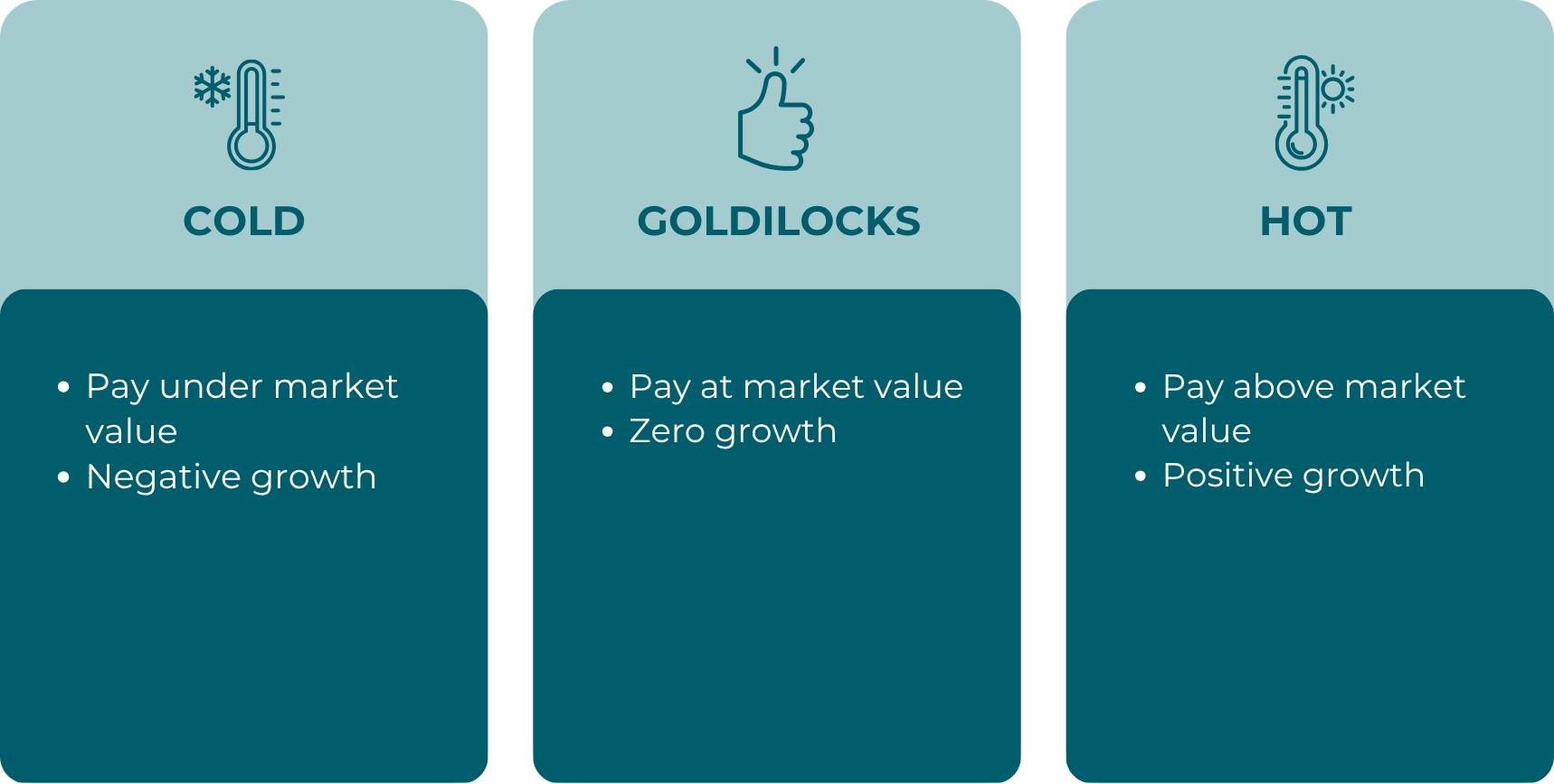
Cold: buyers pay under market value. Prices fall. Negative growth.
Goldilocks: buyers pay at market value. Prices hold steady. Zero growth.
Hot: buyers pay above market value. Prices rise. Positive growth.
A flat market might suit Goldilocks. It does not suit investors. Investors want hot markets.
Capital growth, by definition, means most buyers are paying more than fair market value. Calling it "too much" is calling growth itself the problem.
What "Hot" Actually Means
Hot means demand exceeding supply. Properties sell quickly. Buyers compete. Auctions are hectic. Open inspections are busy. There are too few new properties for sale.
These are symptoms of the fundamental law of economics working as it should. Demand exceeds supply, so prices rise.
Investors should capitalise on this, not fear it.
Demand cannot exceed supply by "too much." The law does not invert at some threshold. The greater the degree to which demand exceeds supply, the greater the pressure on prices to rise.
Prices can fall, but not from demand exceeding supply. Prices fall when demand drops or supply rises. Both are signs of a cooling market, not an overheated one.
History supports this. EBS 27 showed that markets have a tendency to grow at roughly the same rate over the long term. Hot markets cool. Cold markets warm. The lead swaps. The data does not show a hot market staying hot to its own destruction.
"Too hot" does not describe anything that can happen in a property market.
Conclusion
There is no such thing as a market that is too hot. It can feel scary. It can be hard to buy in. But the capital growth a hot market produces is what an investor wants.
The market investors should fear is the cold one. Cold markets are capital growth wastelands. Prices drift sideways or fall. The property the investor just bought is worth less than they paid.
Head towards the heat. Persevere and the rewards follow. But if the market is simply overwhelming, SuburbData's buyers agents deal in these markets regularly and can help you.
The advice to avoid overheated markets is not just wrong. It mistakes a buyer's discomfort for a market's flaw.