

Every few years a familiar claim resurfaces. This cycle is different. You need to pivot to a better strategy. What worked before will not work now.
It sounds like new insight. It is not.
Australian property is diverse. There is almost always a market in a boom somewhere. The strategy was always to find it. A change in one market’s condition does not change the investment strategy.
Strategy Changes With You. Not With the Market.
Strategy is set by personal circumstances, not market conditions:
- Life stage. Young investors need growth. Older investors entering retirement might shift to cashflow.
- Risk tolerance. Younger investors can accept higher risk because time covers mistakes. Nearer retirement, lower risk is usually preferable.
- Income vs growth. Long-term wealth comes from growth. Income matters more closer to retirement.
A change in personal circumstances triggers a change in strategy. A change in the market does not.
There are market changes that require some action. A market peaking is one. A vacancy rate rising is another. But these trigger tactical responses, not strategic ones. The strategy was always to seek out the best growth area. That does not change. Only the location does.
A Common Expert Claim
The phrase resurfaces predictably:
- Adapt to the new phase in the cycle
- Everything is different now
- What worked before will not work now
If everything really is different and the past does not predict the future, then nobody can claim expertise based on what worked before. Including the expert making the claim.
It is an attention-grabbing headline, often triggered by a movement in interest rates, a change in lending, or any property news that briefly dominates the cycle.
It is usually marketing BS dressed as insight.
The Professional's Patch
There is a second reason this claim gets made. Some investment professionals only operate in one patch.
The diagram below shows how this plays out. When the patch slows, the professional has two choices.

When the patch slows, the better move for the client is to send them elsewhere. The convenient move is to keep them in the same area and manage their expectations for growth.
"Adapt to the new phase" sounds like advice. It is often a way of keeping clients in a market the professional cannot leave.
The strategy was always to find the best growth area. The patch is not part of the strategy. Staying put is not usually a good idea. EBS 12 (Long-Term Growth) and EBS 13 (Time-in vs Timing) cover that in detail.
There Is Always a Market in Boom Somewhere
We tracked boom periods across the five major capital cities over the last 30 years. The chart below shows when each city was in boom conditions. Boom is defined as 10% per annum growth or higher. The chart is binary. The city is either in boom or it is not.
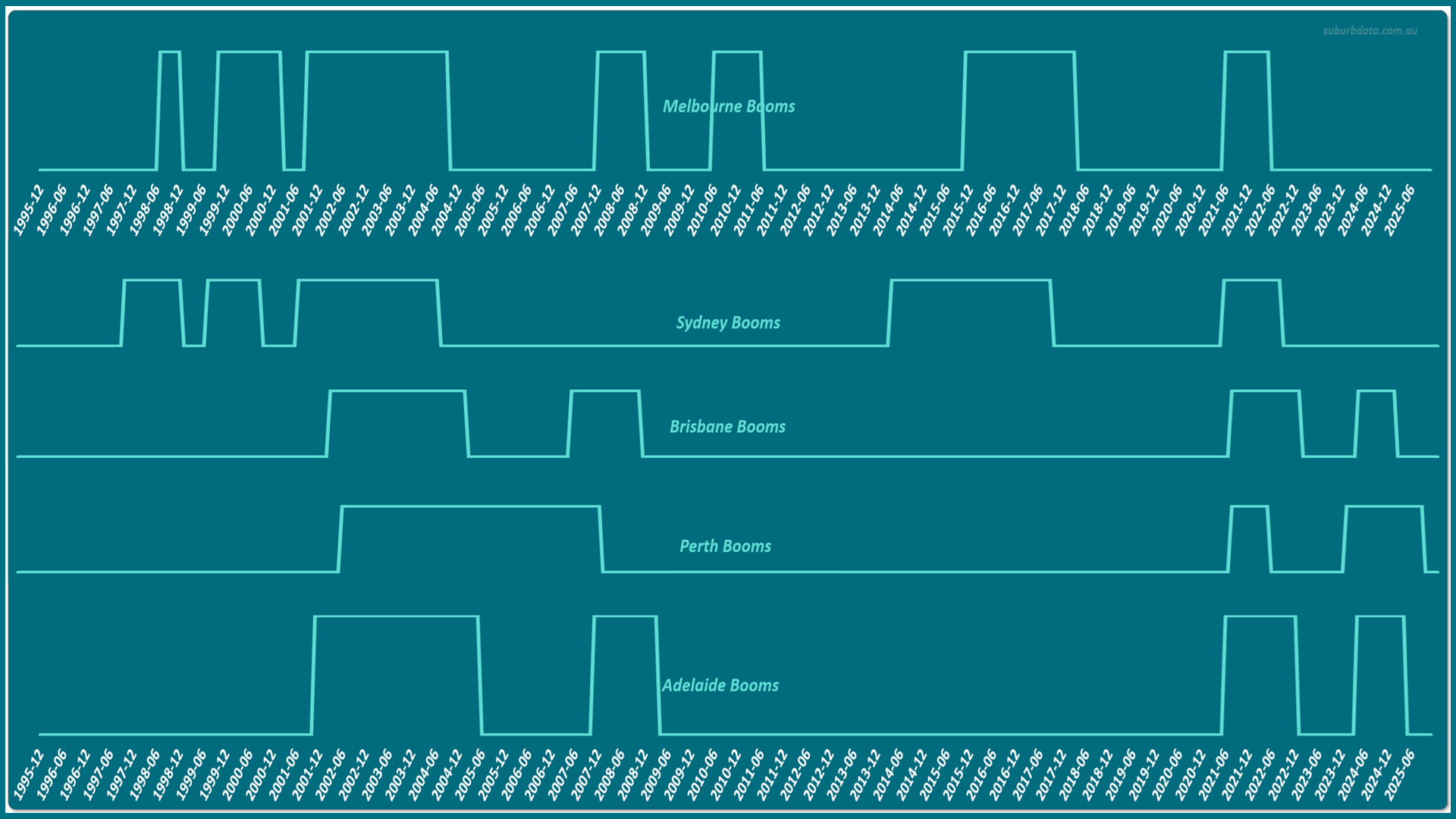
- Period: December 1995 to June 2025
- Duration: 30 years
- Definition: Boom is 10% per annum growth or higher
- Two nationwide booms: early 2000s and from COVID starting 2020
- Gaps when no major capital boomed: late 1990s, 2005-2007, 2011-2014, 2018-2020
The chart only covers five capitals. It does not include Hobart, Darwin, Canberra, or major regional cities like Newcastle, Wollongong, Sunshine Coast, Gold Coast, Geelong, Bendigo, or Ballarat.
It also does not include suburbs within each city. Parts of a city can boom when the city overall is not.
If suburbs were measured instead of cities, the gaps would be smaller. With regional cities and other capitals included, the gaps would close further.
There is never a bad time to invest if you know where to invest.
When Your Market Peaks
When demand and supply return to balance in a market, an investor has three options:
- Sell. Reallocate the proceeds to a better-performing market. The biggest cost is capital gains tax. If bought in your own name, roughly 20% of the gain is lost to CGT. Selling agent fees are around 2%. Stamp duty on the replacement property is around 4%. The replacement market usually needs to forecast roughly 30% more growth than the one being sold to make the move worthwhile.
- Refinance. Pull equity from the underperforming property and use it elsewhere. Easier than selling, but the original property continues to drag. Serviceability limits may also block the refinance.
- Wait. Hold and hope the market recovers. The underperforming asset stays underperforming. Rents usually rise over time, which eventually eases serviceability.
None of these are radical. They have always been the options when a market peaks. Nothing has ever changed about either:
- The options available when markets peak
- The surge-and-slough nature of price movements
Conclusion
Australian property is diverse. There is almost always a market in boom somewhere.
- Strategy: set by personal circumstances, not market conditions
- Patch: not part of the strategy
- When a market peaks: sell, refinance, or wait. The same options that have always existed.
The longer you hold a property for, the more likely you will end up with growth around the same as the national growth rate. Old-school buyer's agents who always invest in the same suburbs year in, year out usually deliver that average.
Steer clear of the old-school buyer's agents claiming the cycle is different. The cycle has always been like this. Some markets are booming. Others are not. The investor's job is to find the ones that are.
The advice to adapt to a new phase is not just wrong. The cycle was never different.
Changes to tax laws are unlikely to affect the key principle behind wealth creation in property investment - capital growth.