

Some investment advisors suggest avoiding property markets known for higher than average expenses. Higher council rates. Land tax. Higher insurance premiums.
The suggestion is that these expenses will have a big impact on your success. They will not.
Capital growth is what makes investing all worthwhile. Every expense is small in comparison.
"Don't Buy There!"
Three categories of expense get cited most often as reasons to avoid a market:
- Land tax
- Council rates too high
- Insurance too high
Where does this advice come from? In some cases, a hidden agenda. A buyer's agent who does not want to research outside their local patch steers clients away from unfamiliar markets.
Each one of the reasons above on its own is not reason enough to avoid any market in Australia.
There are loads of expenses involved in holding an investment property. One thing trumps them all: capital growth.
Some relevant costs follow…
Entry Costs
The biggest entry cost is stamp duty. A conservative estimate now is 5% of the property's value, given bracket creep over the last decade.
An $800,000 purchase incurs an entry cost of about $40,000.
Stamp duty dwarfs legal fees of a couple of thousand and building and pest inspections of about a thousand.
Holding Costs
The biggest holding cost is mortgage interest. At 6.5% and an 80% loan-to-value ratio (LVR), interest costs about 5% of the property's value each year.
Then a cluster of smaller expenses. Management fees, insurance, council rates, repairs and maintenance, land tax, body corporate. Plan for another 0.5% to 1.5% on top of mortgage interest.
Total holding costs sit at around 6% of property value per year. Unless yield exceeds 6%, the property runs at a loss.
But this assumes no capital growth. If location is right, growth makes every other cost look insignificant.
Control Is the Advantage
A $600,000 property paying $2,000 a quarter in body corporate fees is paying $8,000 a year. That feels heavy.
At 5% growth, the same property gains $30,000 in a year. At 10% growth, $60,000.
The $8,000 fee is trivialised by ordinary growth. A 2% lift in capital growth covers it completely.
We have known investors who sold a property over high strata fees. They forked out heaps in agent commission and missed tens of thousands in growth over the following years.
High growth trivialises almost every expense. Low growth exaggerates them all.
What's Your Focus
The diagram below names the trade-off.
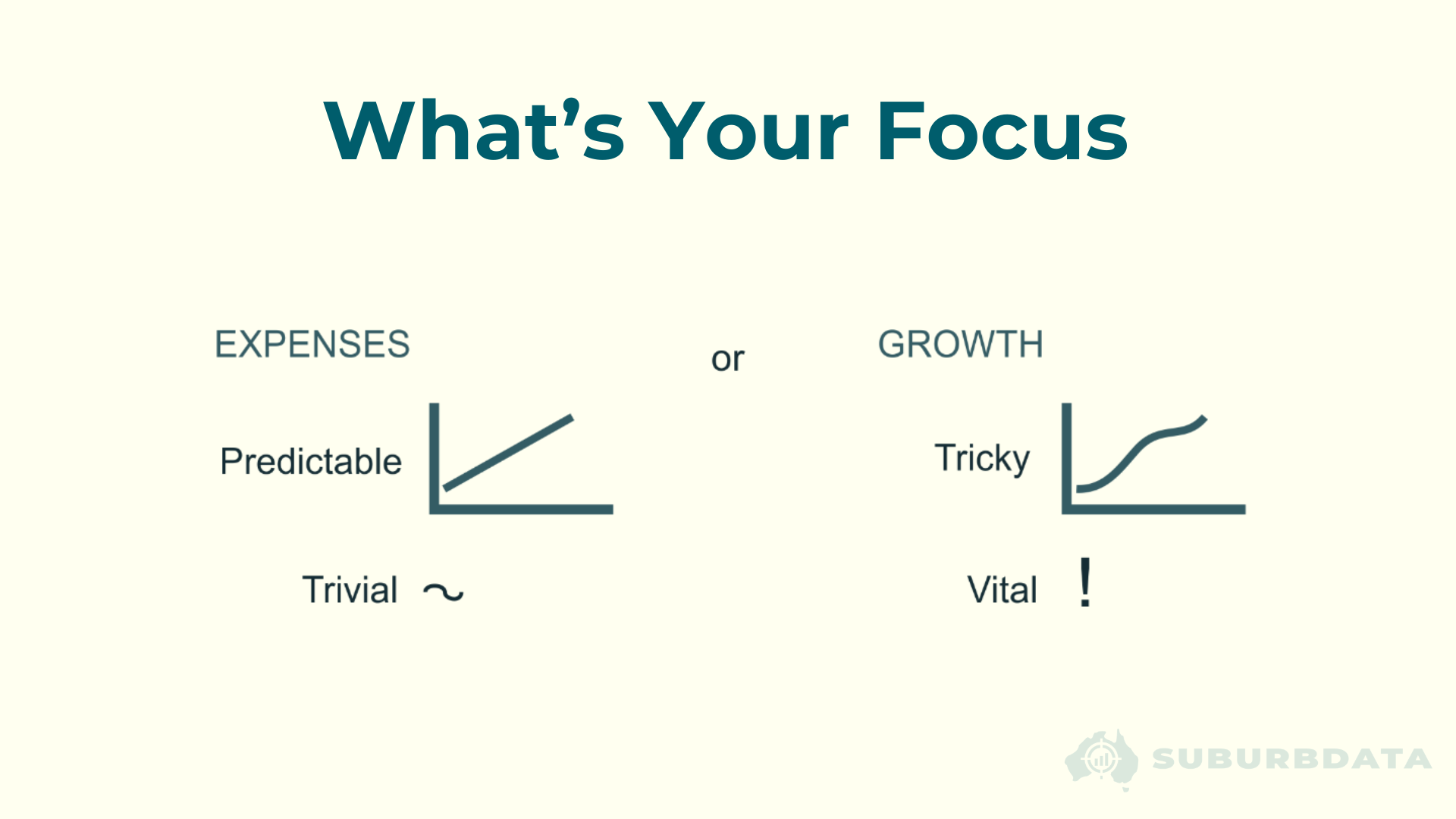
Expenses are predictable. They are also trivial.
Growth is tricky. It is also vital.
Some property professionals cannot predict growth. They fall back onto what they know: expenses.
Similarly, shopping around for the cheapest interest rate is not the best use of your time.
If you have the expertise to predict capital growth, it revolutionises your focus and decision-making. You invest at multiple times the power of a less-informed investor.
Get growth right and it will cover over a multitude of ineptitude in other less important areas.
Case Study: The ACT
A blog by a self-titled "senior property strategist" recommended against investing in Canberra. The reasons cited were high council rates and land tax.
In the Australian Capital Territory (ACT), land tax kicks in from the first dollar of land owned. In other states, a threshold must be exceeded first. Owning one property usually does not trigger land tax. In the ACT, it does.
But the ACT has cheap stamp duty. A $1 million property in Victoria incurs roughly $20,000 more stamp duty than the same property in the ACT.
It might take years of higher council rates and land tax in the ACT to match the higher stamp duty paid up front in Victoria.
Ironically, the senior property strategist was based in Victoria.
The chart below compares ACT and Melbourne house yields.
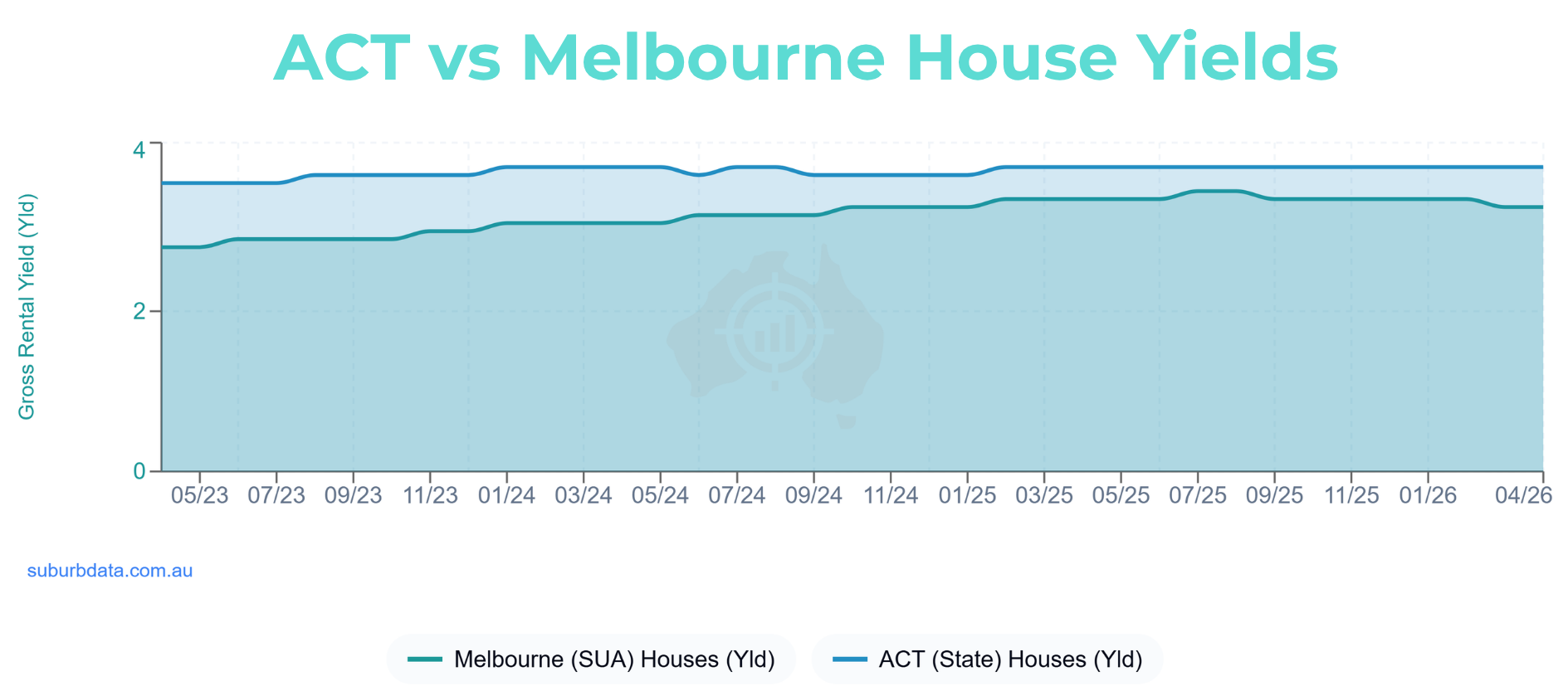
ACT yields have been about 0.5% higher than Melbourne for the last few years. That is an extra $5,000 a year on a $1 million property.
Higher rents in Canberra appear to have already factored in higher council rates and land tax. Even on cashflow alone, there is not much to explain why an investor would avoid Canberra.
All of this pales when growth is considered.
35 Years of Growth
Some advisors claim Canberra cannot keep up with Sydney and Melbourne over the long term. The data says otherwise.
The chart below compares Canberra growth against Melbourne over 35 years.
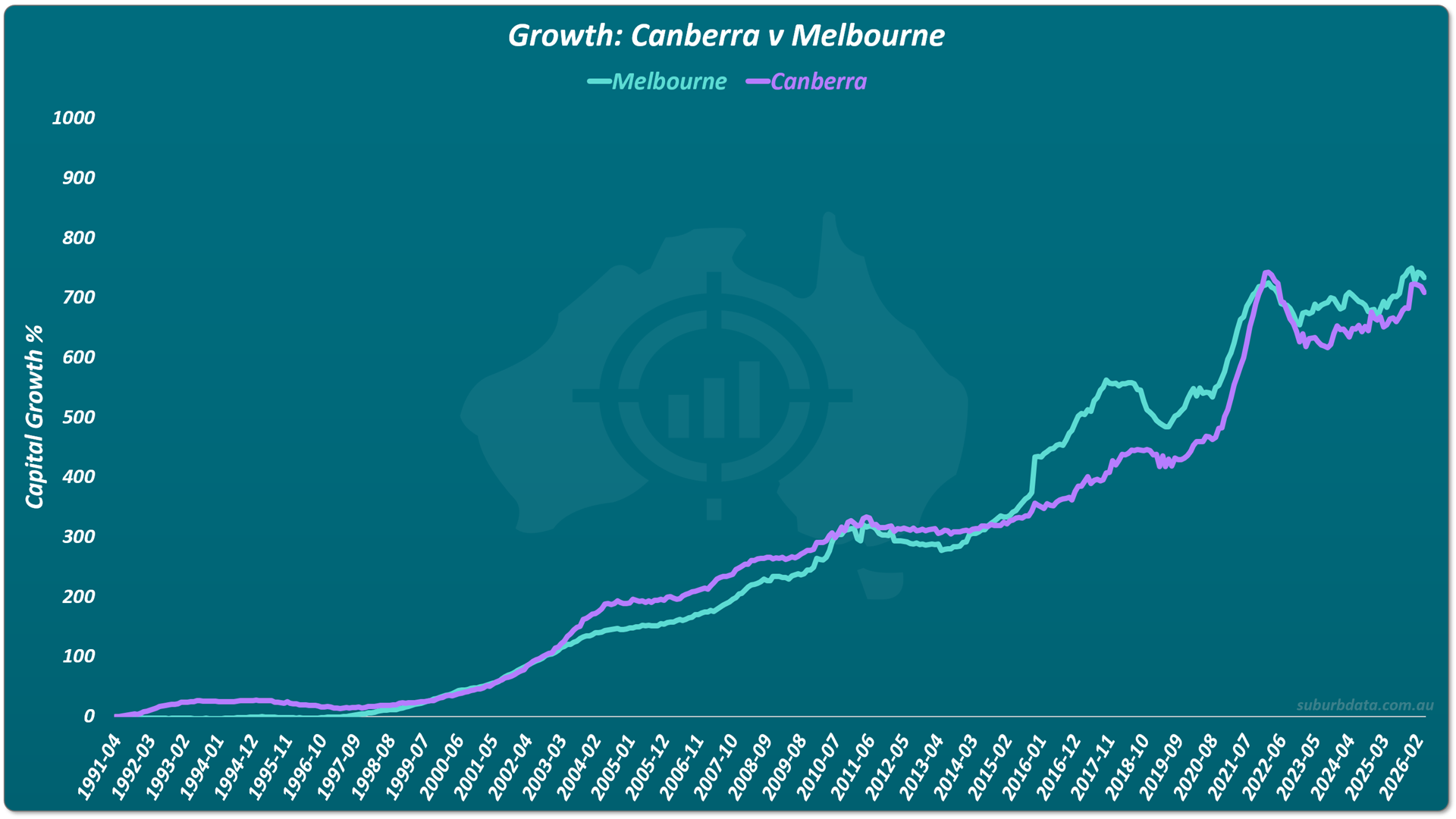
Most readers' eyes go to the top right to see which city won the race. The more valuable insight is how the race was run.
The lead changes about half a dozen times across 35 years. Pick different start and finish dates and you get different winners. Neither market has a consistent long-term advantage.
The chart below shows the same pattern against Sydney.
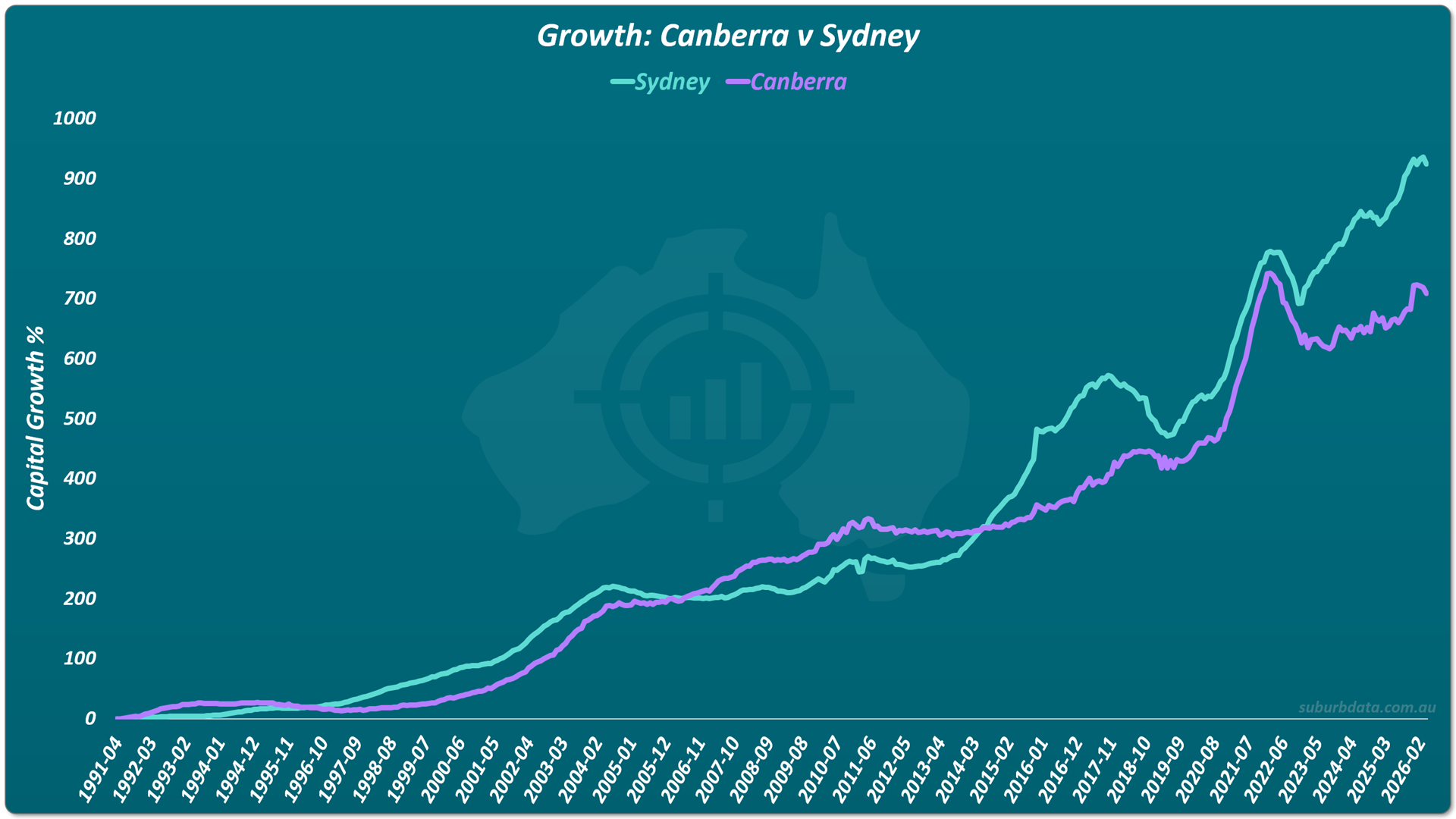
The same pattern repeats. One market gets ahead. The other catches up. The lead changes again.
The big movements happen in the top right. That is the nature of exponential growth. A boom in the 1990s looks like a small ripple compared to ordinary growth recently.
The chart below shows Canberra against Brisbane.
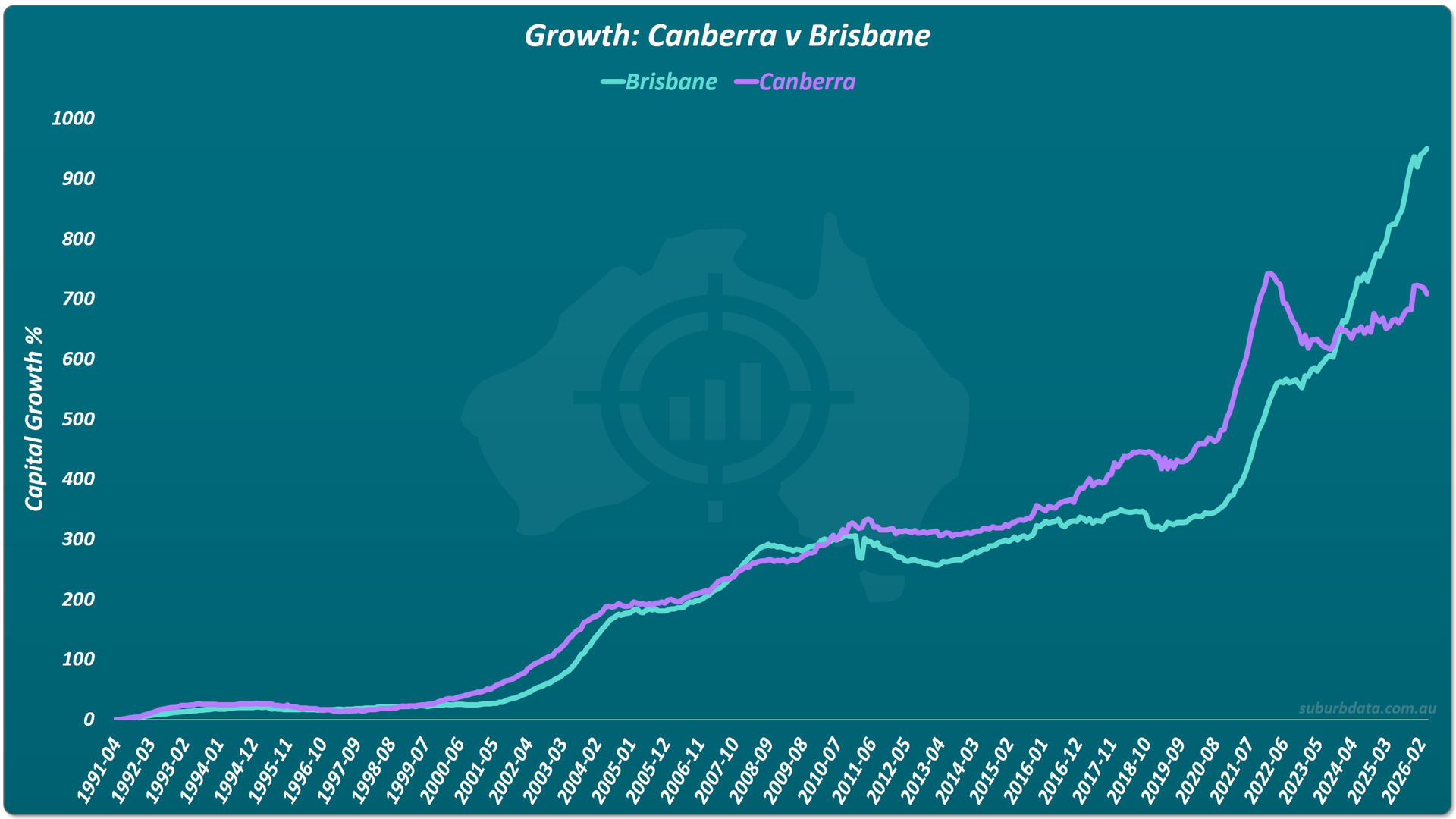
For over a decade Brisbane lagged Canberra. Recently it caught up and overtook.
The chart below shows Perth.
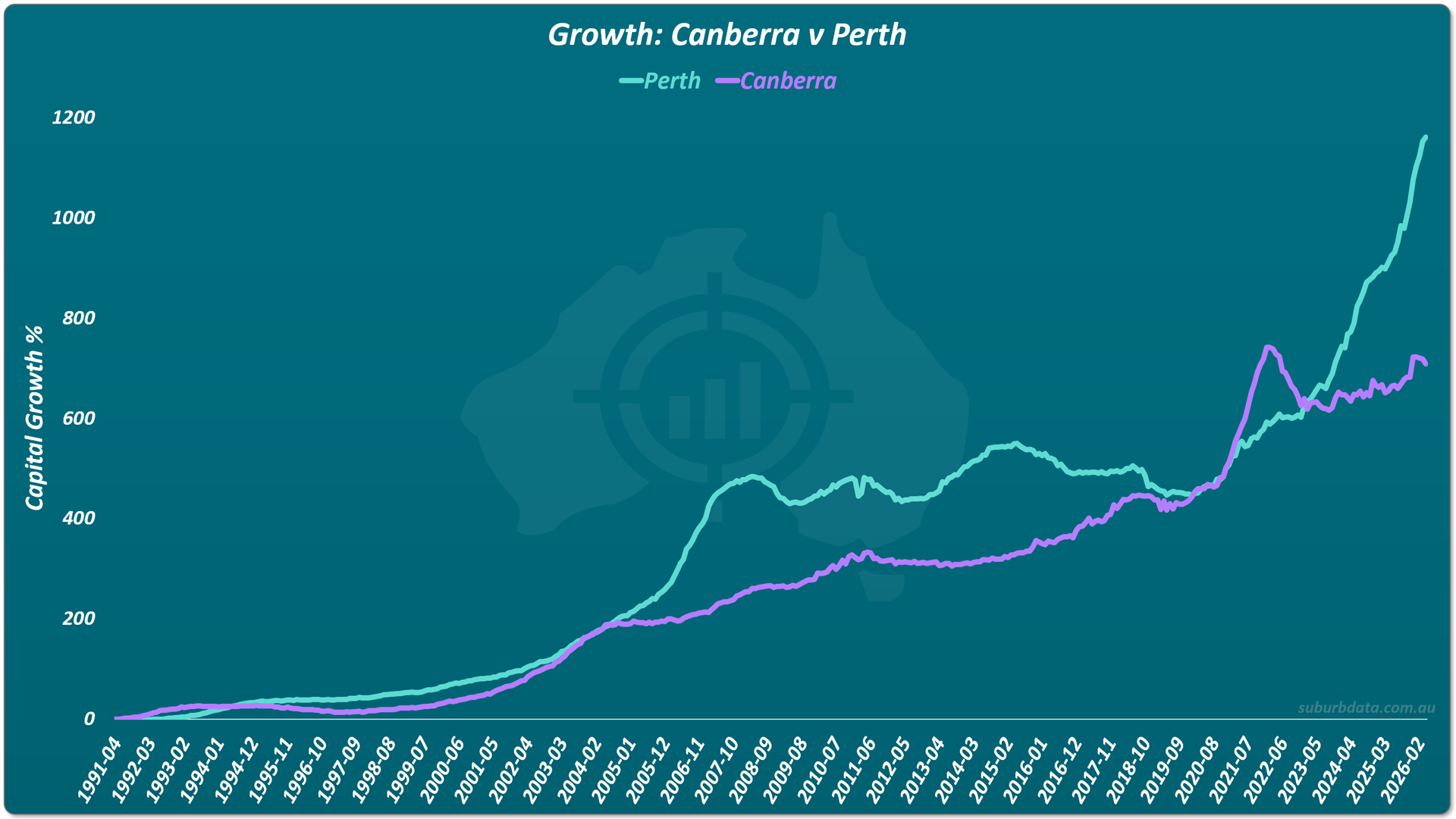
Perth has had three big booms in 35 years. Canberra has had three too. Keep an eye on Canberra over coming years. It will boom again and close the gap.
The chart below shows Adelaide.
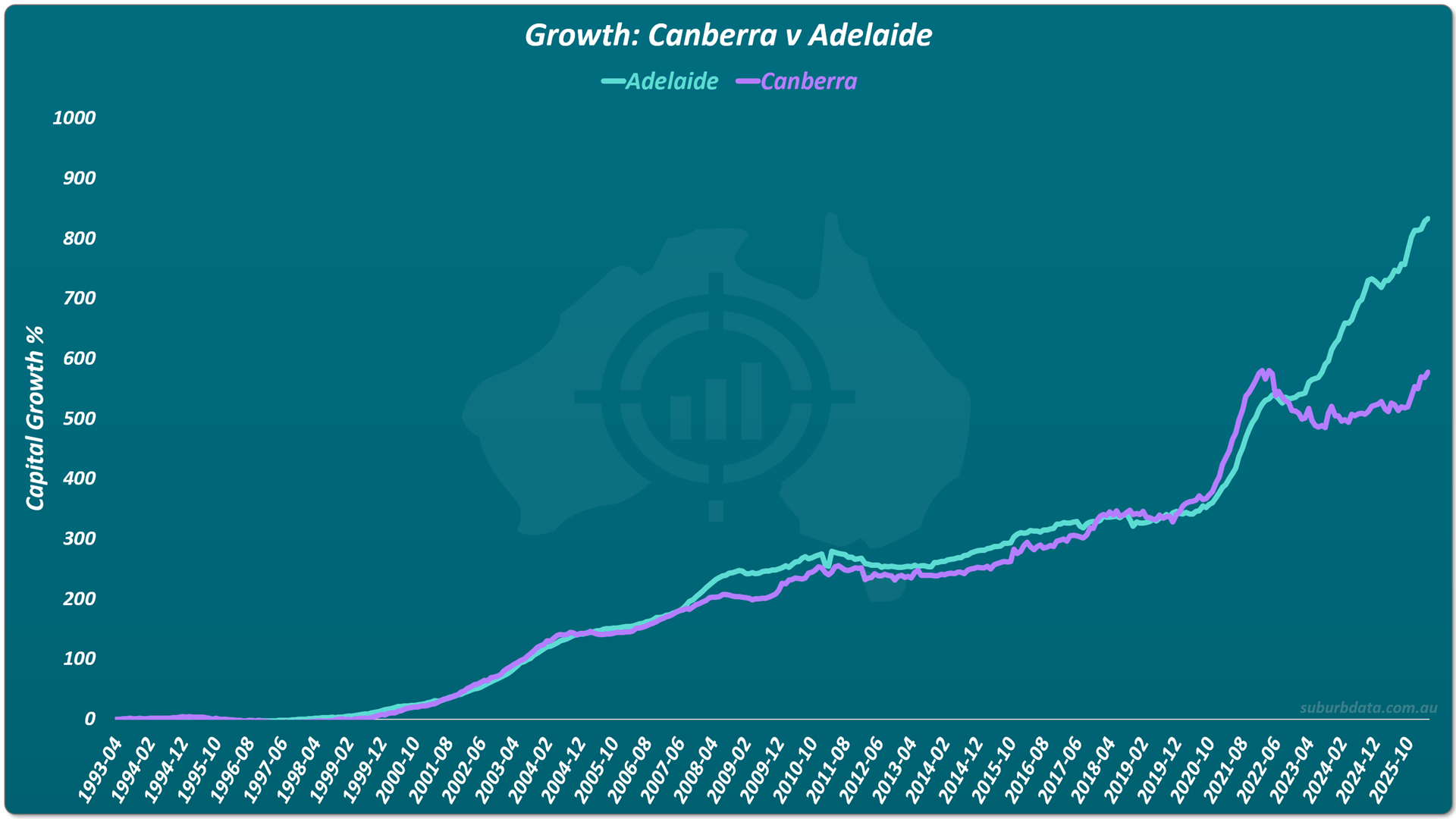
Adelaide's growth history starts in 1993, so total growth is lower because the period is shorter.
The key point is the pattern - the lead changes multiple times.
There is no harm investing in Canberra even over the long-term.
A Note on Short-Term Holding
We do not recommend investors hold over the long-term. Historical data shows short-term holding matters more. EBS 12 (Short-Term Wins Matter More), EBS 13 (Time-In versus Timing), and EBS 31 (Should I Ever Sell?) cover this in detail.
Insurance: Price Meh, Count Important
Canberra is not a trouble-spot for insurance. But cyclones, flooding and bush fires are significant risks in some parts of Australia, and they push insurance premiums up.
But an extra couple of thousand dollars in insurance is small compared to capital growth of tens or hundreds of thousands of dollars.
What would affect capital growth significantly is insurers pulling out of a market. Check there are at least two, preferably three or more, willing to cover the area. It is not about price. It is about whether anyone will insure at all.
Why Experts Got It Wrong
Why is this advice so prevalent? A professional with no real idea what future growth will be has nothing left to focus on but expenses. They pump up trivial issues because the important one is outside their expertise.
Be cautious of experts who talk up small things. It highlights a lack of expertise in what really matters.
Conclusion
Expenses are trivial. Capital growth is the prize.
What matters more than finding lower expenses is finding higher capital growth. Growth trumps every other aspect of property investing.
The reason so many professionals talk up other aspects is that they simply do not know growth. Make sure your investment advisor has a growth focus.
If you want to invest in Canberra, there is nothing wrong with it, even over the long-term.