

Some industry professionals say investors get too much information. They call it analysis paralysis. Their cure is to ignore the data or summon courage and buy.
That is bad advice.
The problem is not the quantity of information. It is the quality.
The Problem Is Not Quantity
You can get the wrong kind of information. You cannot get too much of the right kind.
There are about 40 topics in this Expert Busting Series. That highlights how much of the wrong kind of info is out there.
The quality is the problem. The marketing noise from fake experts makes it worse.
Courage Is the Wrong Cure
Some say courage is the answer to analysis paralysis. It is bad advice.
Fear is a natural consequence of not knowing.
No property investment is risk-free. But with the right information about a property and its market, fear can be reduced significantly.
The cure for analysis paralysis is more information of the right kind. Courage on its own can be dangerous.
Source, Filter, Interpretation
Three things determine whether information is useful:
- Source. Where it came from.
- Filter. How you separate signal from noise.
- Interpretation. What you do with what you have filtered.
Watch for Biased Advisors
The diagram below shows the structural conflict of interest behind some of the free property investment advice in the market.
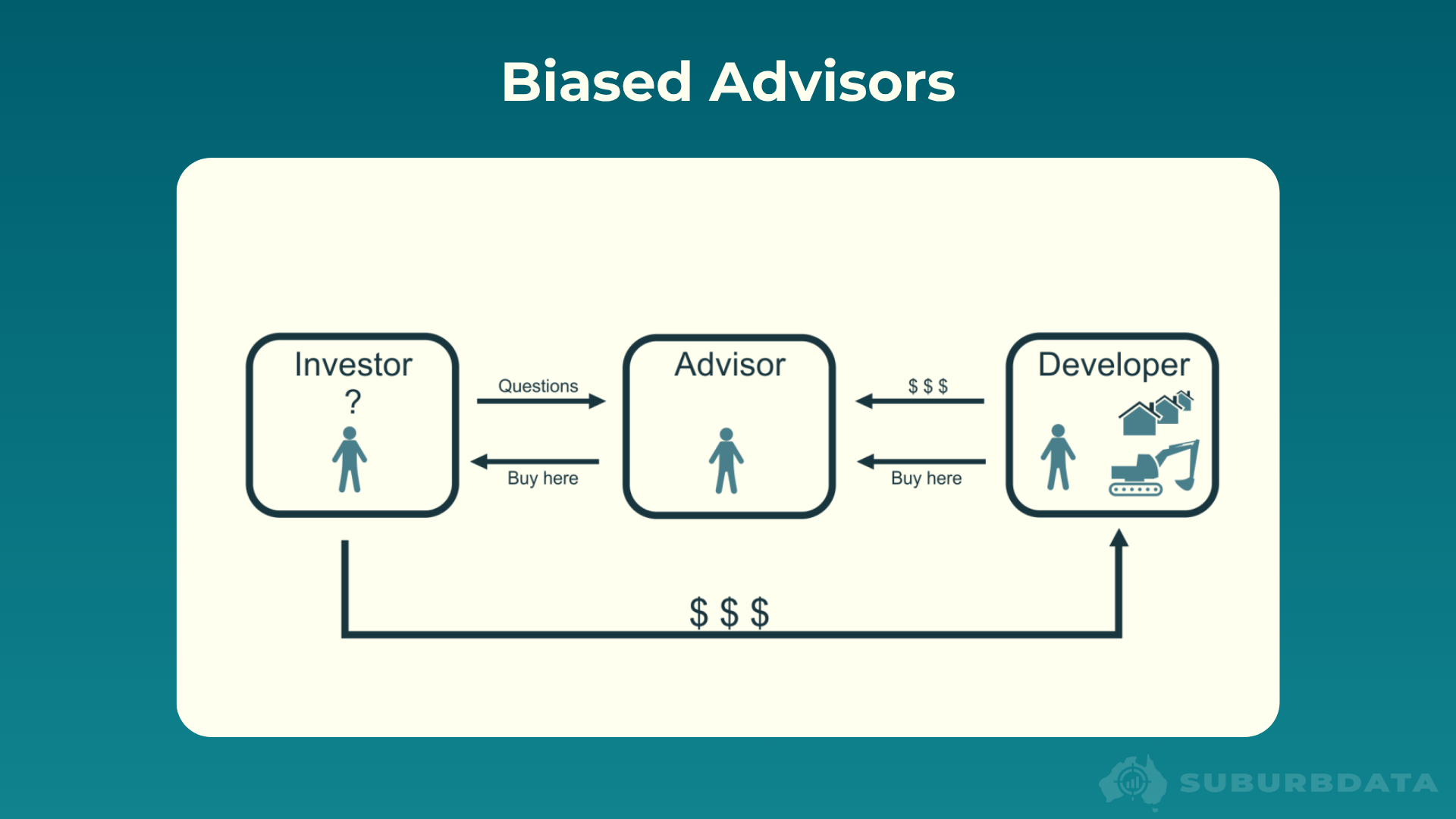
Do not trust any source of data with a vested interest.
Big data providers like Cotality and the Australian Bureau of Statistics (ABS) are fine.
The worst offenders are project marketers, partners of property developers, and property developers themselves. Some developers disguise themselves as property investment advisors. Some set up an advisor arm of their development company. Some partner with a glorified marketing firm that claims to be independent.
Many of these advisors come across as genuine. They want to help. They are also biased.
The questions to ask:
- How do you get paid?
- Do you partner with property developers?
- Do you get a commission, kickback, discount or marketing fee?
- Do you have a shareholding in the development company?
Ask yourself if they are running a charity or a profitable business.
Commissions paid by developers are large. Businesses can fund free webinars and workshops on that revenue. If it's free, there could be a bad reason behind it.
Filter for Supply and Demand
Ignore info that has little to do with supply or demand of property.
Those two aspects alone dictate price movement. The closer your information relates to either supply or demand, the more likely you will make a good decision.
We have seen project marketers reference how a celebrity likes to swim nearby. That is gossip, not research. Unless the goal is appealing to the paparazzi, there is no benefit in that information.
One of the biggest mistakes an investor can make is to buy a new property. New properties tragically underperform older ones. See EBS 3, The Nasty Truth About New Property, for the evidence.
Supply Mistaken for Demand
Some experts mistakenly interpret a supply indicator as a demand indicator and vice versa.
Three commonly misinterpreted topics:
- Population growth. Frequently interpreted the wrong way around. See EBS 1, Population Growth, for the correct framing.
- Past growth. Many professionals get this one wrong too. See EBS 10, Property Growth History.
- Infrastructure. Over-hyped and unreliable as a growth predictor. See EBS 14, Big Projects, Little Payoff.
Six Rules to Avoid Disaster
The right information leads to a short list of rules. Follow these and most of the damage is avoided.
- Avoid new properties. Low land-to-asset ratios and high depreciation. They underperform older stock. See EBS 3.
- Avoid units. A house on a large block can be knocked down and replaced with 50 units. Supply is the enemy of capital growth.
- Avoid vacant land. Greenfield areas can be supplied with thousands of new houses. Buy in an established area where supply is constrained.
- Avoid small towns. A town dependent on a single industry can become a ghost town if that industry fails. Be cautious of any town with a population under 50,000.
- Avoid peaks. The more growth a market has had recently, the closer it is to its peak. See EBS 10 for the growth history evidence.
- Be patient. Time covers a multitude of mistakes. A 20-year horizon forgives most of them. Anyone close to retirement has to get more right.
Conclusion
The conventional advice is to cure analysis paralysis with courage. That is bad advice.
Fear is a healthy warning signal. It tells you that you do not yet know enough. Courage on top of bad information is how investors lose money.
The cure is better information. Source it from providers with no vested interest. Filter it for supply and demand. Interpret it without confusing the two.
Do that and the fear takes care of itself.